

Commission disclosure: This article includes a promotional link to TubeTarget. The guidance is educational and intended to help you decide whether a research tool fits your YouTube ad workflow; it does not promise results.
Direct Answer & Introduction
If you need to assess YouTube channels for contextual ad relevance, start with fit rather than fame: ask whether the channel’s topic, audience expectations, tone, and recent content make the placement logically relevant to your offer. That approach is for advertisers, media buyers, and small teams who need a defensible screening method before any campaign work.
Quick answer
Use topic overlap, likely audience interest, upload patterns, brand safety, and creator tone as your core checks. Do not treat subscriber count, a viral video, or general popularity as proof that a channel is a good placement. As a brief platform-context note, Google Ads Help’s About placement targeting document, checked on 18 September 2026, says placement targeting is available in eligible campaign contexts, while content targeting is not available for video conversion campaigns as described there. Chosen placements still compete in auctions and do not guarantee impressions.
Who this guide helps
This guide is for advertisers comparing channels before they decide where a placement research tool is useful. It separates research, campaign eligibility, and measured outcome so you can make a cleaner decision about which channels deserve deeper review.
What you should be able to do after reading
You should leave with a practical way to score channels, a clearer definition of contextual relevance, and a simple handoff process for turning a rough list into a better one. That improves your shortlist; it does not predict performance.
YouTube placement research briefcampaign-ready review listTubeTarget review
Fundamentals
What contextual ad relevance actually means
Contextual ad relevance asks whether an ad placement makes sense in the setting around it. On YouTube, that usually means the video topic, channel theme, presentation style, and viewer expectations are close enough to your offer that the placement is worth reviewing. It is a screening concept, not proof of buying intent.
Relevance is different from popularity
A channel can be large and still be a weak match if its audience is broad or unrelated to your offer. A smaller channel can be a stronger match if it repeatedly publishes on a narrow subject that lines up with what you sell. The useful question is not “How big is this channel?” but “What kind of attention does this channel reliably attract?”
The main criteria to check
| Criterion | What to check | Why it matters |
|---|---|---|
| Topic fit | Recent uploads, recurring series, and the channel’s main subject | Shows whether the channel regularly covers a relevant context |
| Audience overlap | Likely viewer interests and use cases | Helps you avoid assuming a general audience will behave like a buyer audience |
| Tone and format | Tutorial, review, commentary, news, or entertainment style | Influences whether your offer feels aligned or intrusive |
| Brand safety | Language, sensitive topics, and content adjacency | Protects the brand from obvious mismatch |
| Freshness | How recent the relevant uploads are | Recent content usually gives a better read than an old channel description |
Where a tool fits in the process
A research tool can help you find candidate channels faster, organize them, and export a working list. It cannot replace judgment. If you evaluate TubeTarget as a subscription, the practical question is whether its advertised channel, video, and keyword discovery features save time in your screening workflow—not whether they can manufacture qualified buyers.
Main Process / Strategies
Step 1: define the placement purpose first
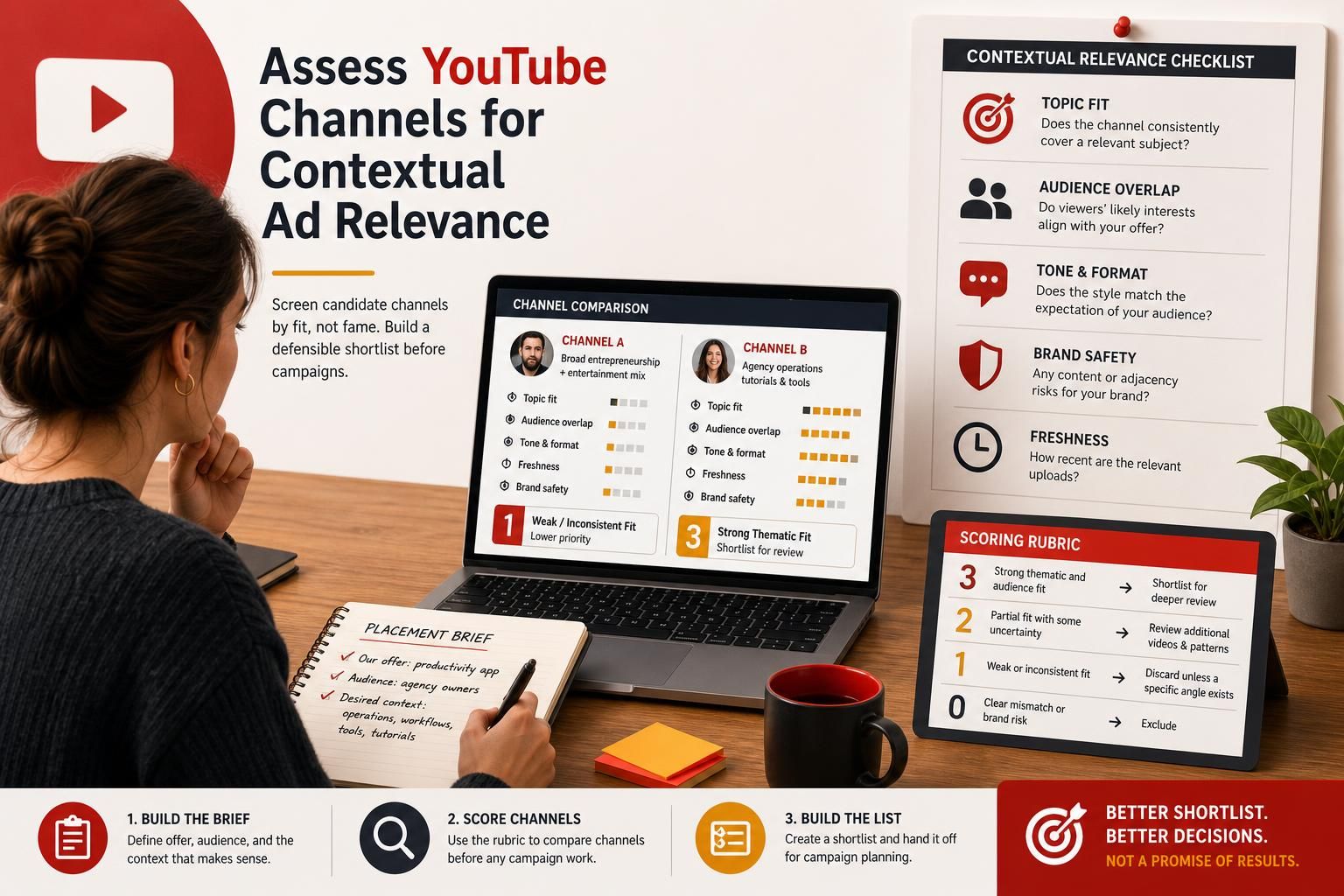
Before you open a channel list, write down the offer, the audience, and the kind of context you want. For example, a B2B software offer may belong near tutorials, comparison videos, or workflow content, while a consumer product may fit reviews or how-to channels. This prevents you from judging channels without a clear standard.

Step 2: score the channel before you get distracted by a single video
Channel-level screening keeps you from overreacting to a viral outlier. Check whether the channel has a stable subject area, a consistent viewer expectation, and a history of relevant uploads. Then review a few current videos to see whether the channel still behaves like its theme.
Step 3: compare two hypothetical channels
Imagine you sell a productivity app for small agencies.
Channel A publishes broad entrepreneurship commentary mixed with entertainment, motivational clips, and occasional business advice. It has larger reach, but the subject matter changes often.
Channel B publishes weekly operations tutorials for agencies, including client management, SOPs, and workflow tools. It is smaller, but the surrounding content is closely connected to the problem your offer solves.
In a contextual relevance review, Channel B would usually deserve the first look because its topic fit is clearer and its audience expectation is more specific. Channel A might still be worth testing later, but only after you confirm that the placement context and creative angle make sense. That is a judgment call, not a claim about clicks, leads, or revenue.
Step 4: use a simple scoring rubric
| Score | Meaning | Typical action |
|---|---|---|
| 3 | Strong thematic and audience fit | Shortlist for deeper review |
| 2 | Partial fit with some uncertainty | Review additional videos and the channel pattern |
| 1 | Weak or inconsistent fit | Discard unless a very specific angle exists |
| 0 | Clear mismatch or brand risk | Exclude |
This kind of rubric matters because it makes your decision visible. If you later hand the list to a campaign planner or media buyer, they can see why a placement was included instead of guessing.
Step 5: separate research from implementation
A placement research workflow may end with a shortlist, a CSV, or a notes file. That is not the same as campaign setup, ad budget planning, or outcome measurement. The official Google Ads Help guidance checked on 18 September 2026 matters here because placement availability depends on campaign context, and not every targeting idea applies to every campaign type. It is also why software cost and ad spend should be handled separately.
Step 6: decide whether the subscription fits your real workflow
TubeTarget’s advertised role is to help users find channels, videos, and keywords, and to organize placement research for Google Ads. If your current bottleneck is manual screening, a tool like that may be useful. If your real bottleneck is offer clarity, creative quality, or budget discipline, software alone will not solve the problem. In that case, the better next step is to improve the brief first and use the tool only to support it.
For readers comparing the offer itself, the official sales page checked on 18 September 2026 advertised Elite Monthly at $27 and Elite Yearly at $97, plus a 30-day refund policy. The page also contained conflicting support descriptions, so current checkout details should be verified before purchase.
YouTube placement research briefcampaign-ready review listad test results
FAQs, Mistakes & Expert Insights
Common mistakes and misconceptions
Mistake 1: using channel size as a proxy for fit. Bigger channels can be better, but only when the subject matter and audience context support your offer. Popularity alone is not a relevance signal.
Mistake 2: confusing relevance with buyer intent. A viewer can care about a topic without being ready to buy. Contextual fit improves the logic of the placement; it does not prove commercial intent.
Mistake 3: screening only the channel homepage. Recent uploads usually tell you more than a static description. Check several recent videos before deciding.
Mistake 4: treating tool output as a final verdict. Research software can speed up discovery, but you still need a human decision layer for brand safety, audience fit, and campaign context.
Mistake 5: mixing research cost with ad spend. A subscription fee is not the same as media budget. Keep those lines separate so the workflow stays readable.
Nuanced insight
The strongest channel decisions usually come from combining a simple rubric with a clear business purpose. That balance helps you avoid two common errors at once: overestimating general popularity and over-trusting a single data point. For advertisers, that usually means fewer speculative placements and a cleaner handoff to the next planning step.
How do I know whether a channel is relevant enough? Start with topic overlap, then check recent uploads, tone, and likely audience use cases. If the fit is still unclear after that, treat the channel as a lower-priority candidate.
Should I target only channels with a narrow niche? Not always. Narrow channels are easier to judge, but some broader channels still work if the specific video context is close to your offer. The point is fit, not niche size for its own sake.
Can a relevant channel still be a poor placement? Yes. A channel can be thematically relevant but still unsuitable because of brand safety issues, weak audience alignment, or content that places your ad in an awkward context.
Is a placement shortlist the same as a launch-ready campaign list? No. A shortlist is a research output. A launch-ready list still needs duplication checks, campaign eligibility review, and budget planning.
Does a tool guarantee better results than manual research? No guarantee is justified. A tool may reduce manual effort and improve organization, but the quality of the final decision still depends on the criteria you use.
assess YouTube channel ad relevancecampaign-ready review listYouTube research tool budget
How do I know whether a YouTube channel is relevant enough for contextual ads?
Start with topic overlap, then check recent uploads, tone, and likely audience use cases. If those signals still do not line up clearly, treat the channel as a weak fit even if it is large or active.
Should I choose only small niche channels?
Not automatically. Smaller channels can be easier to evaluate, but larger channels may still fit well if their content theme and viewer expectations match your offer. Relevance depends on context, not channel size alone.
Can a relevant channel still be a bad placement choice?
Yes. A channel can be thematically close to your offer and still be poor for brand safety, audience alignment, or content tone. Relevance is one input, not the whole decision.
Is a research shortlist the same as a ready-to-launch campaign list?
No. A shortlist is a screening output. Before launch, you still need duplication checks, campaign eligibility review, and budget separation so the list is usable in your actual workflow.
Does a placement research tool guarantee better ad results?
No guarantee is justified. A tool may make research faster and more organized, but the quality of the outcome still depends on your criteria, your offer, and your campaign setup.
Summary & Next Steps
Key takeaways
Assess YouTube channels by contextual fit, not fame. Check topic overlap, audience alignment, tone, freshness, and brand safety before thinking about delivery. Keep research separate from ad spend and separate from performance expectations.
If you use TubeTarget or a similar research tool, judge it by whether it helps you build a better shortlist for your own workflow. That is the practical decision here: whether the tool saves enough time and improves enough structure to support the way you already plan campaigns.
Your next step
Write a simple channel brief, score two or three candidate channels with the rubric above, and compare the results against your offer’s real audience needs. If you want the broader purchasing and workflow context, review the related guides in this cluster, especially the briefing and review-list steps, before deciding on the tool.
Build a placement research brief turn research into a review list see the TubeTarget review
Explore TubeTarget to check the current options against your requirements.
