

Commission disclosure: This article includes a promotional link to the official free-training registration page for 7-Figure Elite Partner.
Direct Answer & Introduction
Before you buy any email marketing programme, write down the questions that would make the purchase easier to judge. That simple step can save you from vague claims, hidden limits, and a mismatch between what you need and what a programme actually includes.
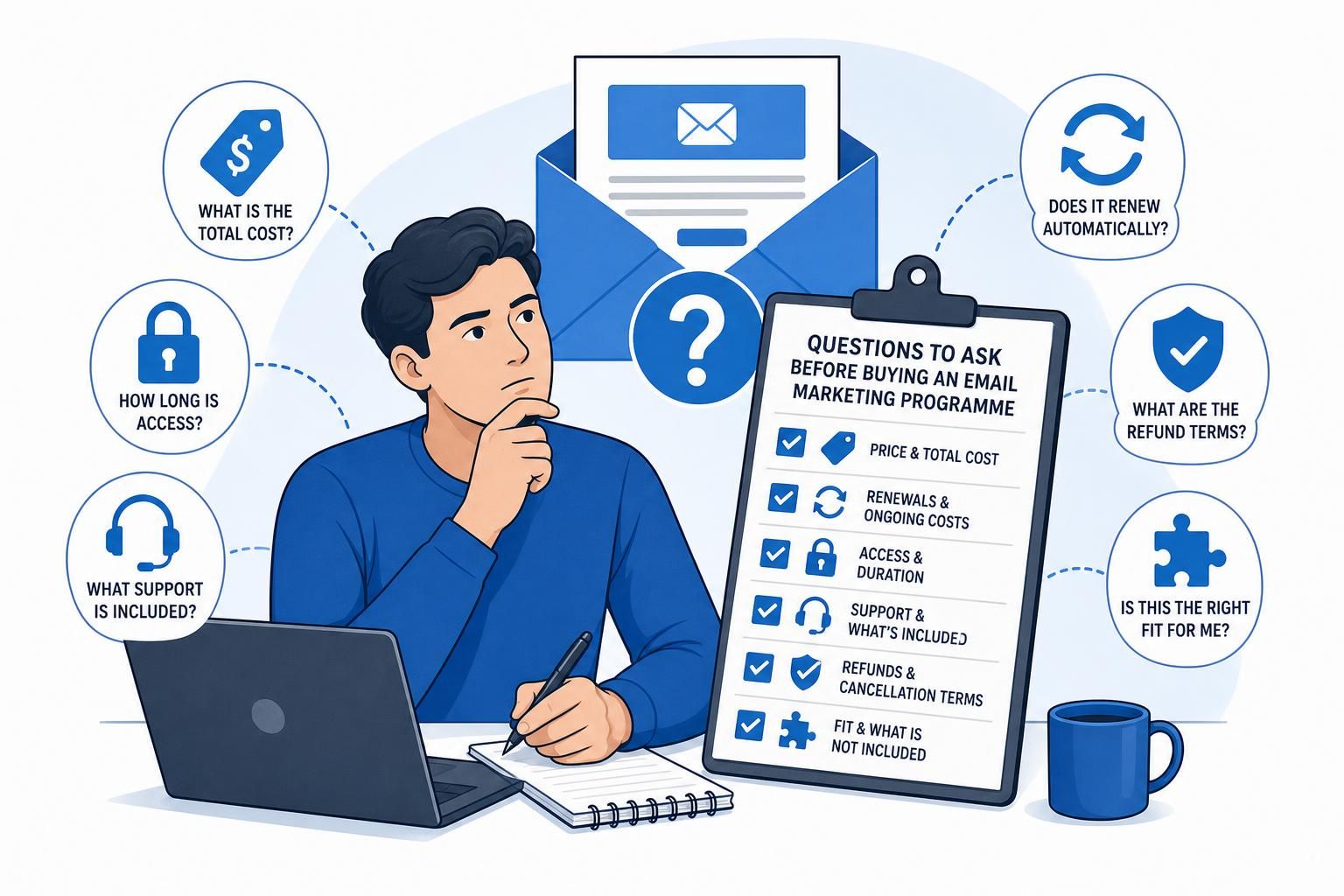
Quick answer: the best questions focus on price, renewals, access, support, refunds, cancellation terms, and whether the programme fits your current stage. If a programme is clearly explained, those questions should have clear answers. If the answers are hard to find, that is useful information too.
This guide is for readers who want a practical due-diligence checklist before they commit to an email marketing programme. It explains what to ask, why each question matters, and how to use the answers without overreading sales language or assuming every paid offer works the same way.
Fundamentals
Why written questions matter
Buying decisions become easier when you turn uncertainty into a short list. Written questions help you compare what the seller says with what you actually need. They also make it easier to spot missing information, especially when a page talks about outcomes but says less about access, renewal rules, or support.
This is not about being negative. It is about making the decision concrete. A programme can sound useful and still be the wrong fit if the pricing structure, delivery method, or support model does not match your situation.
What you are really checking
When people ask whether a programme is “worth it,” they often mean several things at once: Can I afford it? Do I understand the ongoing cost? Will I be able to use it? Can I leave if it is not right? Those are different questions, and each needs a separate answer.
A good checklist therefore covers the basics: the total cost, the duration of access, what happens after the initial term, what support is included, what the refund policy says, and whether the programme requires extra tools or purchases.
Where free training fits in
Free training can help you understand the topic before you buy a programme. It can also show you the presenter's teaching style and the general angle of the offer. But a free session is not the same thing as a full paid programme, and it should not be treated as proof that every later feature, term, or support promise will match your needs.
If you are comparing a programme against a free webinar or registration page, use the free material to clarify the topic and your questions, then use the paid-offer checklist to judge the commercial terms separately.
Main Process / Strategies
Start with the purchase question you need answered
A useful checklist begins with a single question: what would make this programme a good fit for me? For one reader, the answer might be price and renewal structure. For another, it might be support and implementation help. For a third, it may be whether the programme assumes an existing list or advanced skill level.

Once you know that, you can ask better follow-up questions. For example, if you are worried about recurring costs, ask whether access renews automatically, whether software is required, and whether there are separate charges for updates or extras. If you are worried about fit, ask what the programme expects you to already know or already have in place.
Questions about price, renewals, access, and support
These are the first questions most readers should ask because they shape the real cost of ownership, not just the headline price. Ask whether the purchase is one-time or recurring, how long access lasts, whether access to materials changes over time, and what support is included after checkout.
If a programme includes community access, coaching, templates, or software-like tools, ask how long those pieces remain available and whether they depend on an active subscription. A short answer can prevent a long assumption. If the seller does not state this clearly, look for terms before you decide.
Questions about refunds, cancellations, and updates
Refund terms matter because they tell you how the seller handles buyer regret, misunderstanding, or fit issues. Ask whether there is a refund window, what conditions apply, how to request one, and whether any parts of the purchase are excluded. Also ask how cancellation works if the programme renews.
Updates deserve attention too. A programme may be sold as a fixed course, a living membership, or a bundle that changes over time. Those differences affect what you are buying. Ask whether future updates are included, how they are delivered, and whether past materials remain available if the programme changes.
Questions about fit, obligations, and what is not included
Fit questions are often the most practical. Ask what stage the programme is designed for, what experience it assumes, and what results or outcomes it does not promise. Also ask what is not included: traffic, email software, list-building tools, ad spend, implementation support, or one-to-one help.
This matters because a programme can teach a method without supplying the surrounding assets. If you expect the purchase to cover everything, you may judge it too generously. If you know what is excluded, you can decide whether the gaps are acceptable or whether you would need extra spending to apply the training.
Worked example: a simple due-diligence checklist in action
Imagine two buyers looking at the same email marketing programme. Buyer A only checks the headline and the first sales paragraph. Buyer B writes down six questions: total price, renewal, access length, support, refund terms, and what is not included. Buyer B may not buy, but they will at least understand the offer they are judging.
Now add one practical habit: keep a two-column note page. In the left column, write what the seller states. In the right column, write what is still unclear or what you need to confirm. For example:
| What the seller states | What I still need to confirm |
|---|---|
| Programme access is included with purchase | How long access lasts and whether it renews automatically |
| Support is available | Whether support is email-only, community-based, or time-limited |
| Refund terms are mentioned | The exact window, conditions, and exclusions |
This approach keeps you from mixing assumptions with facts. It also gives you a clean record if you later decide the programme is not the right fit.
For a wider evaluation process, compare your notes with how to evaluate an email marketing webinar before registering, the sequence thinking in mapping an email affiliate funnel without assuming sales, and the measurement guidance in track an email affiliate campaign beyond click counts.
FAQs, Mistakes & Expert Insights
Mistakes to avoid when you read a sales page
One common mistake is to treat a confident claim as a full answer. Another is to focus on the topic and ignore the commercial terms. A third is to assume that if a programme sounds useful, the refund, support, and access rules will be easy to discover later. They are not always easy to discover later, so check them while you are still deciding.
It is also easy to overvalue extras. Bonuses can be helpful, but they do not replace clear pricing, cancellation terms, or a fit check. Keep the checklist simple: cost, ongoing obligations, access, support, refund policy, and what is excluded.
Reader FAQs
What should I ask before buying an email marketing programme?
Start with the basics: total price, whether the cost repeats, how long access lasts, what support is included, what the refund terms say, and whether anything important is excluded. Those answers tell you much more than a sales headline.
Do I need to know everything before I register or buy?
No. You usually need enough information to judge fit and cost, not a perfect forecast of every possible outcome. If the seller cannot answer the main commercial questions clearly, that is reason to pause.
Should I ask about software or tools?
Yes, if the programme depends on them. Some programmes assume you already have an email service, landing page tool, or list setup. Ask whether those are included, required, or separate purchases.
Is a refund policy enough to make a purchase safe?
No. A refund policy helps, but it does not replace a fit check or clear terms on access, support, and renewals. Also, refund policies may have conditions or exclusions, so read the details carefully.
How do I use the checklist without becoming overwhelmed?
Limit yourself to a small set of questions and write the answers down in one place. If the purchase still makes sense after you compare the answers with your goals and budget, you have a stronger basis for deciding.
What should I ask before buying an email marketing programme?
Start with the basics: total price, whether the cost repeats, how long access lasts, what support is included, what the refund terms say, and whether anything important is excluded. Those answers tell you much more than a sales headline.
Do I need to know everything before I register or buy?
No. You usually need enough information to judge fit and cost, not a perfect forecast of every possible outcome. If the seller cannot answer the main commercial questions clearly, that is reason to pause.
Should I ask about software or tools?
Yes, if the programme depends on them. Some programmes assume you already have an email service, landing page tool, or list setup. Ask whether those are included, required, or separate purchases.
Is a refund policy enough to make a purchase safe?
No. A refund policy helps, but it does not replace a fit check or clear terms on access, support, and renewals. Also, refund policies may have conditions or exclusions, so read the details carefully.
How do I use the checklist without becoming overwhelmed?
Limit yourself to a small set of questions and write the answers down in one place. If the purchase still makes sense after you compare the answers with your goals and budget, you have a stronger basis for deciding.
Summary & Next Steps
Key takeaways
- Written questions make an email marketing programme easier to judge because they turn vague claims into concrete checks.
- Focus on price, renewals, access, support, refunds, cancellation terms, and exclusions before you buy.
- Use a simple note page to separate what the seller says from what you still need to confirm.
Good due diligence is not about suspicion; it is about clarity. If you know the terms, the limits, and the fit, you can decide more calmly whether a programme belongs in your next step or not.
For a practical next move, compare the paid-offer questions in this guide with the free-training perspective in the 7-Figure Elite Partner free-training registration page and the related cluster articles, then decide what still needs answering before you commit.
Continue with a related guide
For evaluate this particular registration offer, read 7-Figure Elite Partner Webinar: What the Registration Page Reveals.
