

Commission disclosure: This educational guide includes a link to the product page for SuperAffiliatesAI Premium. If you use it, we may earn a commission at no extra cost to you. The goal here is not to hype the tool; it is to help you spot the mistakes that undermine affiliate review channels before you invest time or money.
If you’re trying to build a faceless affiliate review channel, the biggest problem is usually not a lack of software. It’s starting with tools, posting volume, or automation before you understand the channel strategy those tools are meant to support. That order matters because it affects your niche, your audience fit, your trust signals, and how sustainable the channel feels after the first few uploads.
Direct Answer & Introduction
The short answer
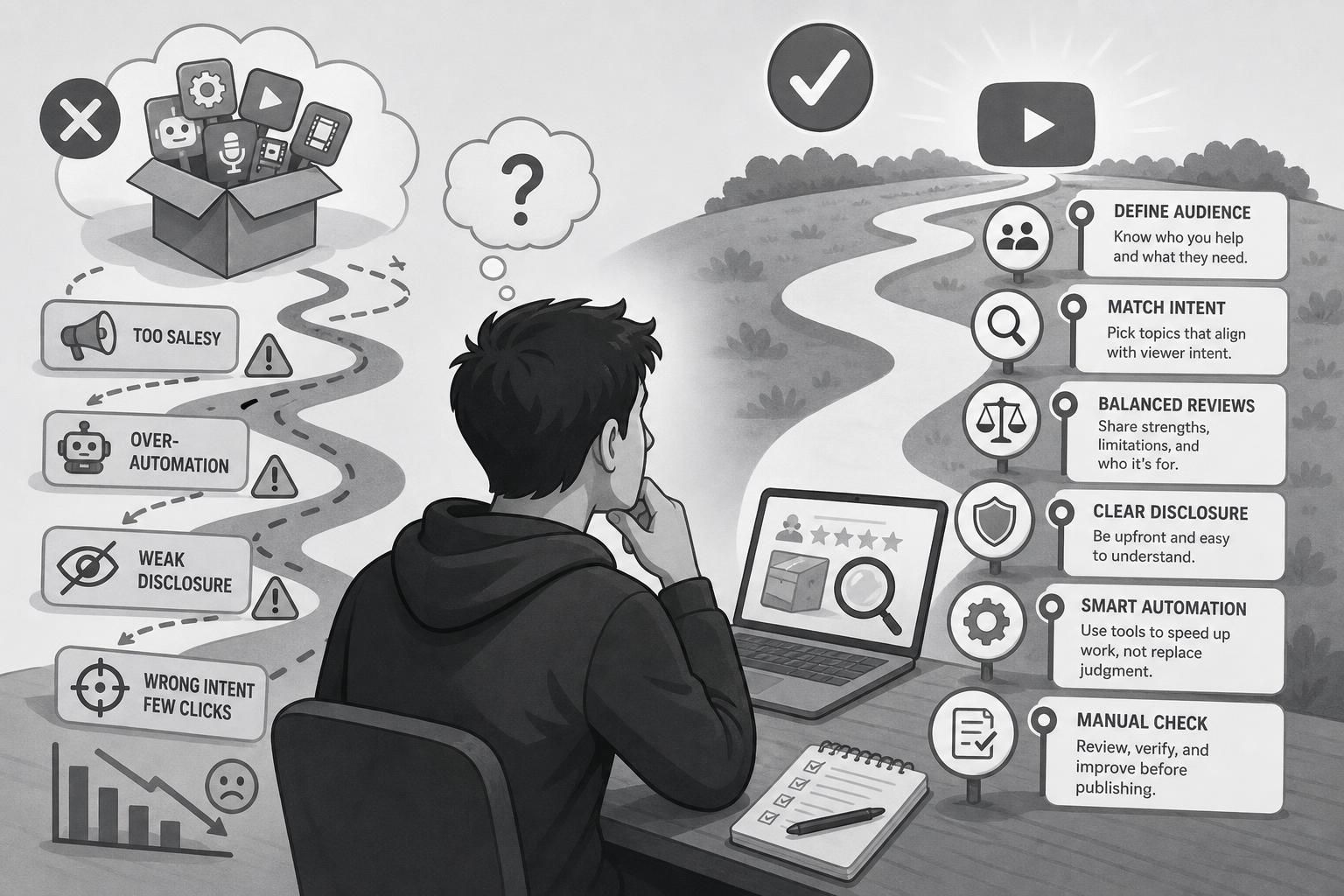
The most common affiliate review channel mistakes are choosing a tool before defining the channel, promoting products that do not match viewer intent, sounding too salesy, over-automating the workflow, and treating disclosure as an afterthought. Fix those five areas and you usually improve both credibility and long-term usefulness.
Who this guide is for
This is for beginners and intermediate creators building product-review channels on YouTube, Shorts, Reels, TikTok, or similar platforms. It also helps if you already post consistently but are not getting qualified clicks, strong watch time, or steady trust from viewers.
What changes when you avoid these mistakes
When the channel is built around audience need instead of software novelty, it becomes easier to explain, easier to maintain, and easier for viewers to trust. That trust is what turns views into clicks and clicks into commissions.
Fundamentals
What an affiliate review channel actually does
An affiliate review channel publishes evaluations, comparisons, walkthroughs, or “is it worth it?” content that helps viewers decide whether a product fits their needs. The format may be faceless or host-led, but the job is the same: guide a decision.
Why strategy should come before software
Tools can speed up production, but they do not decide what your channel should be known for. A solid channel starts with a clear viewer, a clear content angle, and a clear standard for what counts as a useful review. The sales page for SuperAffiliatesAI Premium, checked on 2026-09-25, describes a workflow for discovering products, generating review scripts, creating videos, and publishing content. Those are workflow claims, not proof that any channel will convert or grow.
The principles that keep a channel credible
Three principles matter most. First, match the content to search intent: a buyer-ready viewer wants different information than a casual browser. Second, include strengths and limitations so the review feels useful rather than promotional. Third, make disclosure easy to notice and easy to understand so viewers know how the content is monetized.
Main Process / Strategies
1) Define the channel model before choosing the tool
The first mistake is buying software because it promises automation, then trying to figure out the channel later. A better sequence is simple: choose the niche, define the viewer, decide the review format, and only then compare tools.

Example: If you want to review AI tools for freelancers, your channel should not be built around random trending products. It should focus on the specific problems freelancers actually have, such as speed, pricing, ease of use, and task fit. That gives the channel a clear identity and makes repeat viewing more likely.
2) Match product selection to search intent
Weak product selection is one of the fastest ways to waste effort. A product can be popular and still be wrong for your audience if the viewer’s intent does not match the angle of your video. Someone searching “X scam or legit” wants different information than someone searching “X tutorial” or “X vs Y.”
Some vendor materials, including the one for SuperAffiliatesAI Premium, describe product-discovery features such as pulling offers from networks or analyzing a pasted sales page. That kind of workflow may help with topic discovery, but it does not replace your judgment about whether the product deserves a review or fits the audience.
3) Avoid the “consistent but irrelevant” trap
A common pattern is a creator who posts regularly but targets the wrong buyer stage. They may be producing steady content, but if the topics are too broad, too early-stage, or too promotional, the channel can attract viewers who never click or never buy.
Hypothetical example: imagine a creator posting daily videos about productivity software, but most videos are generic roundups. The channel gets some views, but conversion stays weak because the content never answers purchase-ready questions. The fix is not simply “post more.” The fix is to shift into comparison posts, pain-point reviews, and specific use-case videos such as “best for solo creators,” “best for teams,” or “worth it for beginners?”
4) Keep the review balanced enough to earn trust
Trust drops when every review sounds like a sales page. A useful review should identify strengths, limitations, and fit. That does not mean being negative for its own sake. It means explaining who should consider the product and who should probably skip it.
This matters even more if your workflow uses automation. If a system writes scripts, generates voiceovers, or formats videos quickly, the output can still feel generic unless you edit for judgment, clarity, and audience fit. Automation is a production assist, not a substitute for editorial thinking.
5) Use automation for volume, not blind publishing
Another mistake is treating automation as if it guarantees traffic, rankings, or conversions. In reality, automation can reduce repetitive work, but it cannot create demand on its own. Platforms change, competition changes, and product quality varies.
The sales-page materials for SuperAffiliatesAI Premium describe automated video creation, multi-platform publishing, and an “Auto-Mode” workflow. Treat those as productivity claims, not income claims. Even if a tool saves time, you still need topic judgment, review standards, and periodic manual checks to keep the content useful.
6) Don’t confuse distribution with demand
Some creators assume that if a platform can post to multiple channels, the content will automatically find buyers. Distribution helps, but it does not create demand by itself. A video still needs a relevant topic, a clear angle, and enough usefulness to earn attention.
Short-form content can be useful for discovery, while long-form content often serves research-oriented viewers. The mistake is using the same script everywhere without adapting the pace, promise, or call to action. A short clip may need one concrete question; a long review may need deeper comparisons and stronger explanation.
7) Treat disclosure as part of the review
Disclosure is not just a compliance task; it is also a trust signal. When viewers know you may earn a commission, they can better judge your perspective. Hiding the relationship or burying it in unclear language can reduce credibility and create avoidable risk.
Good disclosure is visible, direct, and consistent across the places your workflow allows, such as the description, captions, or pinned comment. It should be easy to understand without legal jargon.
8) Build a manual review checkpoint
Even if your workflow includes automated script generation or publishing, have a final human check before content goes live. That checkpoint catches obvious factual mismatches, weak phrasing, and overclaims. It also gives you a chance to improve the hook or remove language that sounds too promotional.
This is especially important for software, make-money offers, or products with changing terms. If the sales page changes, your content can become stale quickly. A quick review step before publishing helps reduce that risk.
A practical prevention checklist
- Define the audience before choosing software.
- Confirm the product matches viewer intent.
- Include strengths, limitations, and fit guidance.
- Make disclosures clear and consistent.
- Use automation to speed up work, not replace judgment.
- Adapt format by platform instead of copying one script everywhere.
- Check each piece manually before publishing.
FAQs, Mistakes & Expert Insights
Common mistake: choosing the tool first
This usually leads to a channel shaped around software features instead of audience needs. Start with the review angle, then evaluate whether the tool supports it.
Common mistake: chasing volume without positioning
Posting more helps only if the content has a clear purpose. A large number of unfocused videos often creates noise rather than authority.
Common mistake: overpromising passive income
Automation can reduce effort, but it does not eliminate the need for planning, review, and optimization. A sustainable channel usually mixes systems with editorial judgment.
Common mistake: weak or hidden disclosure
If the audience cannot easily tell how the content is monetized, trust tends to drop. Make the relationship clear early and consistently.
Common mistake: skipping manual review
Even strong automation can produce awkward phrasing, stale references, or weak positioning. A quick human pass is often the difference between content that looks generated and content that feels useful.
FAQ 1: What is the biggest mistake beginners make with affiliate review channels?
The biggest mistake is buying a tool before deciding what kind of review channel they are building. That often leads to scattered content, weak positioning, and unclear audience fit. Start with the viewer problem, then choose tools that support that strategy.
FAQ 2: Can automation replace manual review entirely?
No. Automation can help with research, drafting, formatting, and publishing, but it cannot fully replace judgment. You still need to verify claims, check tone, and make sure the content matches the audience and platform.
FAQ 3: Why do some consistent channels still fail to convert?
Because consistency alone is not enough. If the topics do not match purchase intent, or if the reviews sound generic, viewers may watch but not click. Conversion usually improves when content becomes more specific, more balanced, and more aligned with what the viewer is trying to decide.
FAQ 4: How important is disclosure in affiliate content?
Very important. Disclosure helps viewers understand your incentive and protects the credibility of the channel. It should be easy to find and easy to understand.
FAQ 5: When should I ask for outside help or do a manual review?
If you are unsure about compliance language, if a product claim looks unclear, or if a workflow is producing repetitive content that no longer sounds useful, get a second review. Outside help is especially useful when you are working with regulated, technical, or fast-changing offers.
What is the biggest mistake beginners make with affiliate review channels?
The biggest mistake is buying a tool before deciding what kind of review channel they are building. That often leads to scattered content, weak positioning, and unclear audience fit. Start with the viewer problem, then choose tools that support that strategy.
Can automation replace manual review entirely?
No. Automation can help with research, drafting, formatting, and publishing, but it cannot fully replace judgment. You still need to verify claims, check tone, and make sure the content matches the audience and platform.
Why do some consistent channels still fail to convert?
Because consistency alone is not enough. If the topics do not match purchase intent, or if the reviews sound generic, viewers may watch but not click. Conversion usually improves when content becomes more specific, more balanced, and more aligned with what the viewer is trying to decide.
How important is disclosure in affiliate content?
Very important. Disclosure helps viewers understand your incentive and protects the credibility of the channel. It should be easy to find and easy to understand.
When should I ask for outside help or do a manual review?
If you are unsure about compliance language, if a product claim looks unclear, or if a workflow is producing repetitive content that no longer sounds useful, get a second review. Outside help is especially useful when you are working with regulated, technical, or fast-changing offers.
Summary & Next Steps
What to remember
Affiliate review channels usually struggle because the creator starts with tactics instead of strategy. The fix is straightforward: define the audience, match the product to intent, keep the review honest, disclose clearly, and use automation as support rather than a replacement for judgment.
Your next move
If you want to go deeper, use the related guides on how faceless affiliate review channels work, how review content converts, and a simple 30-day launch plan. If you are comparing tools, evaluate them against the channel strategy first, not the other way around.
If you want to inspect the workflow claims for the product mentioned above, the page for SuperAffiliatesAI Premium is a starting point for that comparison.
Continue with a related guide
For commercial investigation, read SuperAffiliatesAI Premium Review: Is It Worth It for Faceless Affiliate Review Channels?.

[…] tools carefully, see the tool evaluation guide. If you want to avoid common channel errors, the mistakes guide is the better next […]
[…] How to Judge an AI Review Content Tool Before You Buy, Affiliate Review Content That Converts, Common Mistakes in Affiliate Review Channels, A Simple Affiliate Review Channel Launch Plan for the First 30 […]
[…] how faceless affiliate review channels work, how to judge an AI review content tool before you buy, common mistakes in affiliate review channels, and a simple 30-day launch plan. For a product-specific evaluation, return to the pillar review of […]
[…] common setup errors and workflow traps, Common Mistakes in Affiliate Review Channels and How to Avoid Them goes deeper into what usually derails new […]