

Affiliate disclosure: This guide includes a promotional link to SuperAffiliatesAI Premium. I’m using it as a practical reference point for review-workflow thinking, but the teaching here is educational: the structure, trust signals, and editing principles apply whether you create reviews with software or manually.
If your review content feels too salesy, too vague, or too hard to trust, the fix usually starts with structure. A strong affiliate review script gives readers a clear problem, enough context to judge the product, a balanced look at what it does and does not do, and a reasoned next step. For creators building faceless or voice-led review content, that same framework can make a short script easier to follow and easier to believe.
This guide is for affiliate creators, channel builders, and marketers who want review content that is clearer, more credible, and more useful to searchers. It focuses on script anatomy, trust-building language, and practical editing choices that improve readability, accessibility, and conversion without exaggeration. For a product-level walkthrough of a faceless channel workflow, see the related pillar review of SuperAffiliatesAI Premium.
Direct Answer & Introduction
The core answer
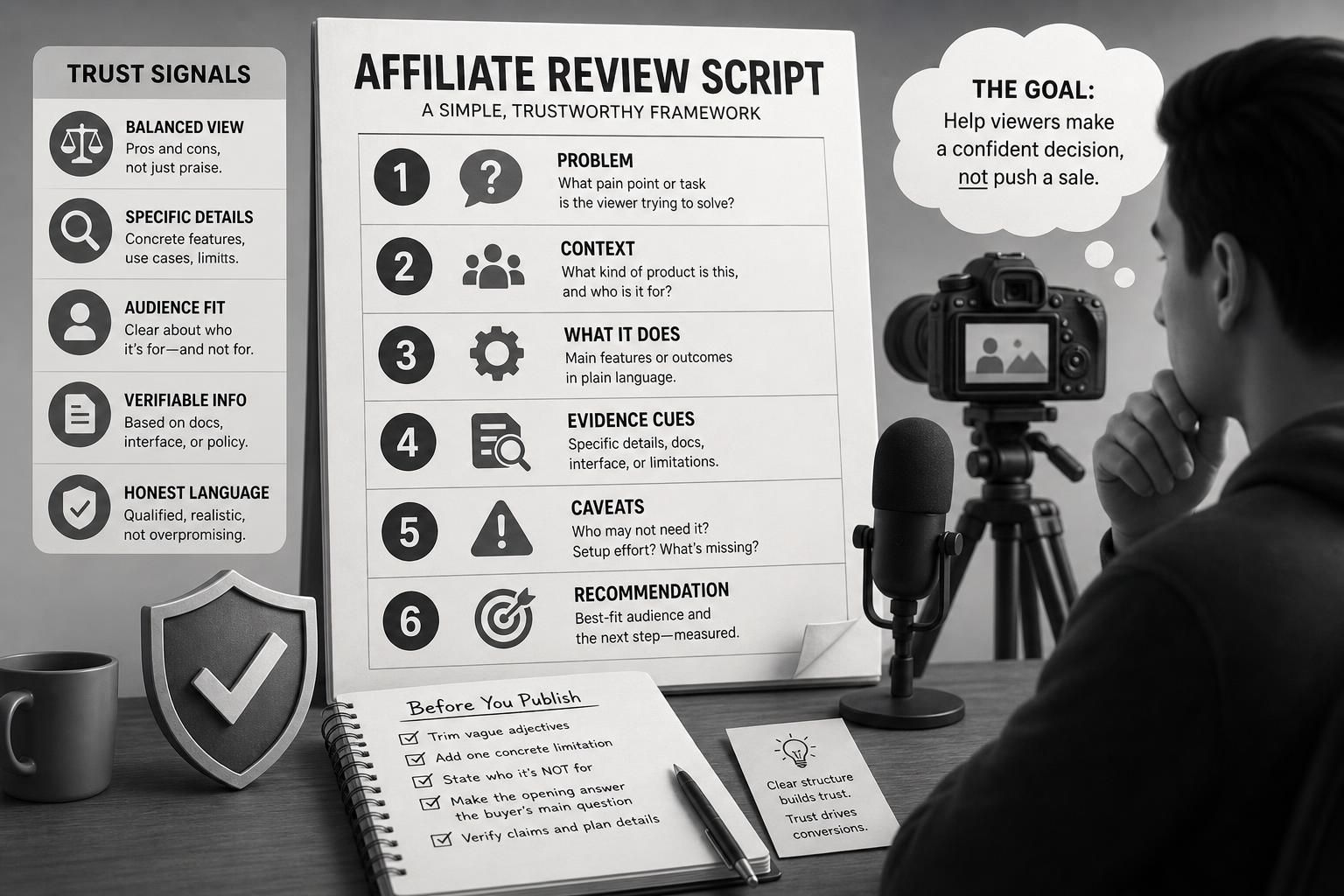
An effective affiliate review video script usually follows a simple arc: identify the viewer’s problem, explain the product’s context, walk through the main features or outcomes, note the caveats, and end with a measured recommendation. That structure works because it mirrors how a cautious buyer thinks. It does not try to force a decision; it helps the viewer make one.
Who this is for
This is most useful if you publish product reviews, faceless channel content, comparison videos, or short-form affiliate explainers and want the content to feel more credible. It also helps if you are trying to move away from generic “Top 5” style content and toward scripts that sound informed, specific, and honest.
What changes when the structure improves
When a script has a clear flow, the viewer spends less effort figuring out what you mean and more effort deciding whether the product fits. That usually improves watchability, reduces confusion, and gives you a better chance of earning trust before the call to action appears. In practical terms, the best scripts are not the loudest; they are the easiest to verify mentally.
Fundamentals
What “review script structure” means
In this context, structure means the order and purpose of each part of the script. A review script is not just a list of features. It is a guided argument: here is the problem, here is what the product claims to solve, here is what matters, here is what to watch out for, and here is the fair conclusion.
Trust signals, explained simply
Trust signals are the details that make a review feel grounded rather than promotional. They include balanced wording, specific observations, clear limitations, a realistic audience fit, and language that distinguishes what the product does from what it merely claims. A trustworthy script sounds like someone helping a buyer decide, not someone trying to win a bet.
Why balance matters in affiliate content
Balance does not mean being negative. It means showing enough context for the viewer to judge suitability. If you only repeat benefits, viewers may assume the review is an ad. If you only highlight flaws, they may never understand the use case. The middle ground is usually more persuasive because it feels more complete.
Main Process / Strategies
A practical script framework
Use this structure for a concise review segment:

- Problem: What pain point or task is the viewer trying to solve?
- Context: What kind of tool, offer, or product is this, and who is it for?
- What it does: Summarize the main functions or expected outcome in plain language.
- Evidence cues: Point to visible details, official documentation, interface elements, or stated limitations.
- Caveats: Explain who may not need it, where setup effort exists, or what is not included.
- Recommendation: State the best-fit audience and next step without overpromising.
A short worked example
Example only: imagine a faceless video tool for affiliate creators. A credible 45–60 second segment might sound like this in outline form: “If your main problem is turning product research into publishable review content, this tool aims to reduce the manual steps. It focuses on product discovery, script drafting, and platform-ready output, which is useful if you are short on time or do not want to film yourself. The trade-off is that automation still needs human judgment: you should check factual claims, confirm licensing or usage limits, and decide whether the tone fits your audience. So this is best for creators who want a faster workflow, not for people expecting fully hands-off publishing with no review at all.”
That outline works because it names the problem, the likely audience, the main value, and the limitation. It gives viewers a decision frame instead of a sales pitch.
How to adapt the structure for different products
You can keep the same skeleton and swap the specifics. For software, emphasize setup, workflow, and output quality. For a course, emphasize what it teaches, what it leaves to the learner, and what prior skill is assumed. For a physical product, emphasize build, use case, maintenance, and fit. The structure stays stable; the evidence changes.
Language choices that build credibility
Credible scripts tend to use precise, qualified language. “Helps with” is safer than “guarantees.” “Designed to” is more careful than “will.” “May be useful if” is more honest than “perfect for everyone.” Those phrases do not weaken the content; they make it harder for the viewer to dismiss the review as hype. Likewise, mention what the viewer can verify: visible features, stated requirements, included assets, or documented limitations.
Editing steps that improve readability and conversion
Once the script is drafted, read it as if you were the buyer. Cut repeated claims. Replace abstract praise with concrete examples. Break long sentences so they are easier to follow in voiceover. If the content is for video, add on-screen labels for the problem, the caveat, and the recommendation so viewers can scan quickly. If the content is faceless, the visual layer should support the script rather than compete with it.
For creators who want a broader channel workflow that includes product discovery, review generation, and publishing, the official sales page for SuperAffiliatesAI Premium describes the vendor’s intended use case and checked feature set as of 2026-09-25. As with any paid tool, treat plan scope and any connected-service requirements as separate from the headline offer.
FAQs, Mistakes & Expert Insights
Common mistakes that break trust
One of the biggest mistakes is writing like a brochure. If every sentence sounds enthusiastic, viewers stop hearing distinctions. Another mistake is using vague claims such as “powerful,” “game-changing,” or “works great” without explaining what that means in practice. A third is skipping limitations entirely. If a product needs setup, has platform restrictions, or works better for one niche than another, leaving that out can make the review feel selective rather than helpful.
Misconceptions about “honest” review content
Some creators think honesty means adding a criticism just to sound fair. That is not enough. Real trust comes from showing judgment: what the product is for, what it is not for, and what level of effort the buyer should expect. Another misconception is that a strong review must be long. Often, a shorter script with better structure will outperform a longer one that wanders.
Why two-voice formats can help
A balanced two-voice format can improve clarity because it separates enthusiasm from scrutiny. One voice can explain the use case, while the other asks the practical questions a buyer would ask: What is included? What still needs manual checking? Who benefits most? Used well, that back-and-forth can feel more natural than a single uninterrupted pitch. Used badly, it becomes theatrical and obvious. The value is in the tension, not the performance.
Evidence-supported nuance for creators
There is no universal script formula that guarantees performance. What consistently helps is reducing ambiguity. Clearer claims are easier to follow, easier to verify, and easier to trust. Likewise, content that states the audience fit and the boundary conditions usually performs better with serious buyers than content that speaks in absolutes. That is a practical rule, not a promise of results.
Five quick reader questions
1) How long should a review script be?
Long enough to answer the buyer’s real questions, short enough to stay focused. For many affiliate videos, that means a tight opening, a few core points, one limitation section, and a clear close. If the script starts repeating itself, it is already too long.
2) Should I mention drawbacks in every review?
Yes, if they are real and relevant. A drawback does not weaken the review when it helps the viewer decide. It strengthens the review by showing that you are not hiding anything important.
3) Is a conversational tone better than a formal tone?
Usually, yes, if your audience is casual buyers or creators. Conversational does not mean sloppy; it means direct, plain, and easy to scan. Formal language can work in some niches, but clarity matters more than sounding impressive.
4) Can I reuse one structure across multiple products?
Absolutely. Reuse the framework, not the wording. Keep the same problem-context-features-caveats-recommendation flow, then tailor the specifics to each product so it does not feel generic.
5) What should I check before publishing?
Verify the product claims, check any licensing or platform constraints, confirm whether a paid plan includes all the functions you are describing, and make sure the wording matches the actual offer. If a connected service or separate account is needed, say so plainly.
How long should a review script be?
Long enough to answer the buyer’s real questions, short enough to stay focused. For many affiliate videos, that means a tight opening, a few core points, one limitation section, and a clear close. If the script starts repeating itself, it is already too long.
Should I mention drawbacks in every review?
Yes, if they are real and relevant. A drawback does not weaken the review when it helps the viewer decide. It strengthens the review by showing that you are not hiding anything important.
Is a conversational tone better than a formal tone?
Usually, yes, if your audience is casual buyers or creators. Conversational does not mean sloppy; it means direct, plain, and easy to scan. Formal language can work in some niches, but clarity matters more than sounding impressive.
Can I reuse one structure across multiple products?
Absolutely. Reuse the framework, not the wording. Keep the same problem-context-features-caveats-recommendation flow, then tailor the specifics to each product so it does not feel generic.
What should I check before publishing?
Verify the product claims, check any licensing or platform constraints, confirm whether a paid plan includes all the functions you are describing, and make sure the wording matches the actual offer. If a connected service or separate account is needed, say so plainly.
Summary & Next Steps
The practical takeaway
Good affiliate review content is not built on excitement alone. It is built on structure, fit, and restraint. Start with the viewer’s problem, explain the product in plain terms, include one or two meaningful caveats, and finish with a recommendation that reflects the audience rather than the hype.
Your next actions
Before you publish your next review, try this checklist: trim vague adjectives, add one concrete limitation, state who the product is not for, and make the opening answer the buyer’s main question sooner. If you are using a tool-based workflow, compare the output against the official documentation and current plan details rather than assuming every feature is included in every version.
If you want to keep building your knowledge around faceless affiliate content, see the cluster guides on how faceless affiliate review channels work, how to judge an AI review content tool before you buy, common mistakes in affiliate review channels, and a simple 30-day launch plan. For a product-specific evaluation, return to the pillar review of SuperAffiliatesAI Premium.
Continue with a related guide
For commercial investigation, read SuperAffiliatesAI Premium Review: Is It Worth It for Faceless Affiliate Review Channels?.

[…] pillar. For the workflow side of review channels, the supporting guides on faceless channel basics, conversion-friendly scripting, and launch planning can help you judge fit more accurately. If you are evaluating […]
[…] How Faceless Affiliate Review Channels Work, How to Judge an AI Review Content Tool Before You Buy, Affiliate Review Content That Converts, Common Mistakes in Affiliate Review Channels, A Simple Affiliate Review Channel Launch Plan for […]