

Commission disclosure: This guide includes an affiliate link to SuperAffiliatesAI Premium. If you buy through it, we may earn a commission at no extra cost to you. This article is educational and focuses on launch planning, not earnings promises or a product verdict.
If you want to start a faceless affiliate review channel without getting overwhelmed, the answer is to narrow the launch. Your first 30 days are for choosing one niche, publishing a small but steady batch of content, and learning what viewers actually respond to. The outcome to aim for is not instant income; it is a channel you can run consistently, measure honestly, and improve with evidence.
Direct Answer & Introduction
What this 30-day plan is for
This plan is for a new creator who wants a realistic, beginner-friendly launch. It works best if you are trying to build a focused review channel around one audience and one content promise. In month one, the goal is to prove your workflow, not to prove a business model overnight.
Why a narrow launch helps
A narrow start makes every decision easier. If your channel is about “beginner AI tools for solo workers,” it is much easier to pick products, write review angles, and interpret results than if you try to cover everything from software to gadgets to courses. Clarity helps the audience understand the channel and helps you understand whether your content is landing.
For a broader overview of the channel format, see How Faceless Affiliate Review Channels Work: A Beginner’s Guide.
Fundamentals
Key terms for the first month
An affiliate review channel explains products so viewers can decide whether to learn more, and the creator may earn a commission if a viewer buys through a tracked link. A niche is the topic lane you stay in, such as productivity software, fitness equipment, or AI marketing tools. A repurposed clip is a shorter version of a longer review, usually adapted for a short-form platform.
The principles that keep the launch sane
Three ideas matter most in the first month: clarity, consistency, and measurement. Clarity means your videos serve one audience and one problem. Consistency means you publish often enough to see patterns. Measurement means you track simple signals such as impressions, clicks, and watch time instead of trying to infer success from a single comment or a feeling.
If you are comparing tools before you commit, the framework in How to Judge an AI Review Content Tool Before You Buy is a useful companion because it helps separate genuine workflow support from vendor hype.
Main Process / Strategies
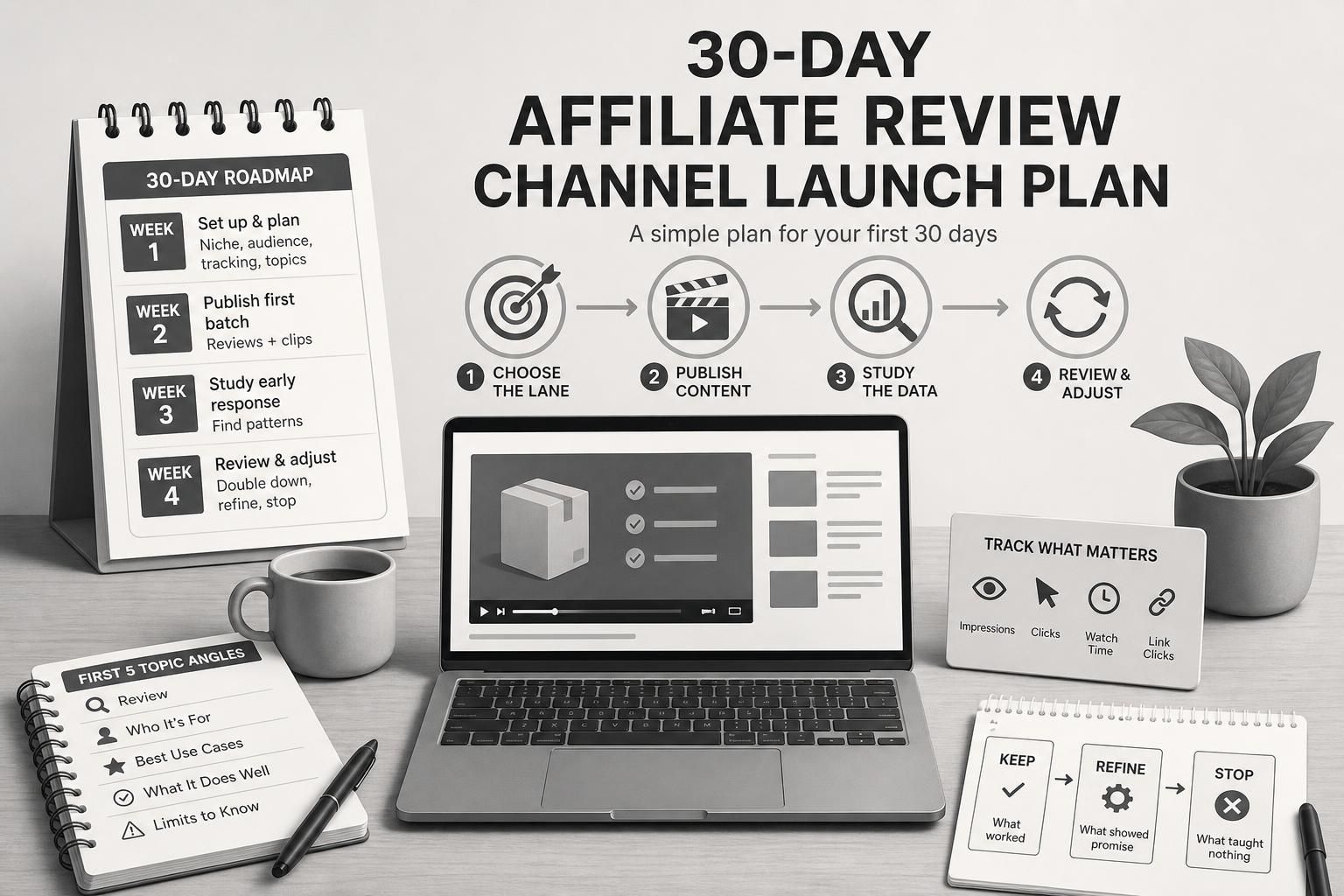
Week 1: choose the lane and set up the basics
Start by deciding on one niche, one audience, and one primary publishing platform. For a first launch, it is usually easier to build around one long-form channel and repurpose into short clips later than to try to manage several platforms at once. Set up the account, basic branding, and a simple tracking system before you publish anything.

A spreadsheet is enough for month one. Track the date, product, topic angle, destination link, impressions, clicks, and notes. You do not need a complicated dashboard to learn whether your content is getting traction; you need a record you will actually update.
Worked example: If your niche is beginner productivity software, your audience might be “solo workers who want simpler workflows.” That gives you a filter for choosing products. You would review tools that help with notes, planning, or task management, rather than every software launch you see.
Week 1: map the first five topics
Before you publish, map the first five content angles. Useful starter angles are review, setup, who it is for, what to watch out for, and best use cases. These are not random topic ideas; they are buyer-intent angles that answer the questions people usually have before they click.
Example: A creator covering beginner AI writing tools might plan one general review, one “who it suits,” one “best use cases,” one “what it does well,” and one “limits to know before you buy.” That gives the channel a coherent first cluster instead of a scattered pile of unrelated uploads.
Week 2: publish the first batch
In week two, publish your first reviews and create at least one short clip from each long-form piece if your workflow allows it. The exact number depends on your time, but the right pace is the one you can repeat without burning out. A reasonable starter rhythm might be two full reviews in the week plus two or three short clips per review, especially if you are still learning how long scripting, editing, and upload prep take.
Keep the structure stable. A simple format is: problem, product summary, strengths, limits, and next step. The point of using the same structure is not to sound formulaic; it is to make your own analysis easier. When each video follows a similar shape, you can tell what changed and what mattered.
For help with structure, scripting, and trust signals, see Affiliate Review Content That Converts: Scripting, Structure and Trust Signals.
Week 3: study the early response
By week three, you should have enough data to look for patterns. Maybe one title style gets more impressions because it matches a common search phrase. Maybe a shorter clip gets more clicks on mobile. Maybe a review that clearly states who the product is for holds attention better than a generic overview. Those are useful signals even if the numbers are small.
Try not to treat early underperformance as a final verdict. A month-one sample is usually too small to justify dramatic conclusions. It is better to ask which topics earned attention relative to their exposure than to ask why the channel is not “working” yet.
Week 4: run a simple review-and-adjust loop
At the end of the month, group your results by topic, format, and response. Look at which videos earned the most impressions, which held attention longest, and which links received clicks. Then decide whether to keep the strongest topic lane, tighten the hook, or reduce formats that created noise rather than useful feedback.
A practical loop is: keep what clearly worked, refine what showed promise, and stop repeating formats that taught you nothing. If you are using an AI-assisted workflow, this is also the moment to check whether the tool is helping you publish clearer reviews or simply producing more content without better judgment.
What a realistic 30-day rhythm can look like
One workable rhythm is a setup week, two content-heavy weeks, and one review week. Another is one longer review every few days, plus short clips in between if you have the capacity. The exact cadence matters less than whether you can sustain it after the first burst of enthusiasm.
Hypothetical example: A beginner might publish four to six full reviews in the month, then turn each review into one or two short clips. That is enough to create a small test library without pretending month one needs to be a full-scale media operation.
Where SuperAffiliatesAI can fit, if you want automation support
If you want help with product discovery, script drafting, and content creation, SuperAffiliatesAI Premium is positioned as an AI-assisted workflow for faceless affiliate review content. On the vendor’s sales page, checked on 2026-09-25, the offer is described as able to search product sources or analyze a product URL, generate review scripts, create video assets, and support publishing workflows. The page also presents commercial-rights and one-time-payment claims. Those are vendor claims, not independent test results, and any connected-service or platform-eligibility requirements still need your own verification.
FAQs, Mistakes & Expert Insights
Common mistakes in the first 30 days
One common mistake is trying to cover too many niches at once. That makes your data messy and your audience signal weak. Another is changing the format every time, which makes it hard to learn what viewers actually prefer. A third is over-focusing on vanity metrics like subscriber count before you have enough content to judge the channel properly.
A related misconception is that you need a perfect brand before you can learn anything. In practice, a small and focused launch teaches more because the feedback is easier to interpret. The point is not to look established; it is to build a feedback loop you can trust.
It is also worth being careful with automation. AI can speed up drafting and production, but it does not replace editorial judgment. If a tool helps you publish more while making the reviews vague, generic, or misleading, it can damage trust rather than build it. Strong reviews stay clear about what the product does, who it is for, and what trade-offs a viewer should know.
Reader Q&A 1: How many videos should I publish in the first 30 days?
Aim for a number you can sustain and evaluate. For many beginners, a small batch of full reviews plus a few repurposed clips is more realistic than trying to post daily immediately. The best target is the one that lets you keep quality steady and learn from the results.
Reader Q&A 2: Do I need to be on camera to start?
No. A faceless format can work if the script is clear and the visuals support the point of the review. What matters most is whether the viewer can quickly understand the product, the use case, and the trade-offs.
Reader Q&A 3: Should I review one product or many products in the first month?
One niche with several related products is usually better than random variety. That lets you learn one audience well and compare similar offers without confusing the channel identity.
Reader Q&A 4: What metrics matter most in month one?
Start with impressions, clicks, watch time or retention, and the ratio of clicks to views if you have link data. These signals help you see whether the topic, title, or hook is doing its job. Income may come later; learning what attracts attention comes first.
Reader Q&A 5: How do I know whether to keep going after 30 days?
Keep going if you have a clear niche, a repeatable production process, and at least one or two content patterns worth testing again. If the channel feels scattered, tighten the focus before adding more volume.
For common setup errors and workflow traps, Common Mistakes in Affiliate Review Channels and How to Avoid Them goes deeper into what usually derails new creators.
How many videos should I publish in the first 30 days?
Aim for a number you can sustain and evaluate. For many beginners, a small batch of full reviews plus a few repurposed clips is more realistic than trying to post daily immediately. The best target is the one that lets you keep quality steady and learn from the results.
Do I need to be on camera to start?
No. A faceless format can work if the script is clear and the visuals support the point of the review. What matters most is whether the viewer can quickly understand the product, the use case, and the trade-offs.
Should I review one product or many products in the first month?
One niche with several related products is usually better than random variety. That lets you learn one audience well and compare similar offers without confusing the channel identity.
What metrics matter most in month one?
Start with impressions, clicks, watch time or retention, and the ratio of clicks to views if you have link data. These signals help you see whether the topic, title, or hook is doing its job. Income may come later; learning what attracts attention comes first.
How do I know whether to keep going after 30 days?
Keep going if you have a clear niche, a repeatable production process, and at least one or two content patterns worth testing again. If the channel feels scattered, tighten the focus before adding more volume.
Summary & Next Steps
Your month-one goal in one sentence
The goal of the first 30 days is to launch one focused review channel, publish enough content to gather real feedback, and use that feedback to sharpen the niche, format, and workflow.
What to do next
Choose one niche today, map your first five topics, and set up a basic tracking sheet before you publish. Then review the first month honestly and adjust the channel based on evidence instead of hope. If you want the broader channel model, start with the beginner guide. If you want a tool-evaluation framework, read the buying guide. If you want setup-error prevention, use the mistakes guide. If you want to explore an AI-assisted workflow, revisit SuperAffiliatesAI Premium with a clear launch plan in mind.
Continue with a related guide
For commercial investigation, read SuperAffiliatesAI Premium Review: Is It Worth It for Faceless Affiliate Review Channels?.

[…] the related guides on how faceless affiliate review channels work, how review content converts, and a simple 30-day launch plan. If you are comparing tools, evaluate them against the channel strategy first, not the other way […]
[…] you are ready to move from understanding the model to planning your first rollout, the 30-day launch plan gives you a simple […]