

Commission disclosure: This article includes one promotional link to the front-end SerpSling AI Lite offer. The guidance below is educational and meant to help you compare budget options, not to push one path as universally best.
If you’re choosing between doing AI search work yourself or paying for agency help, the real issue is usually not the label on the service. It’s whether your budget can absorb the total work involved: planning, content updates, technical changes, review cycles, and ongoing maintenance. For a solo marketer, small business owner, or agency lead with limited bandwidth, the best-fit option is the one that gets the right pages improved without creating hidden costs in rework or delay.
AI search visibility is still evolving, so this guide focuses on practical budget trade-offs rather than hype. If you want a plain-English definition of the field first, see what AI search optimization means in plain English. Here, we’ll compare DIY, software-assisted workflows, and agency support from the perspective of time, risk, and execution.
Direct Answer & Introduction
The short answer
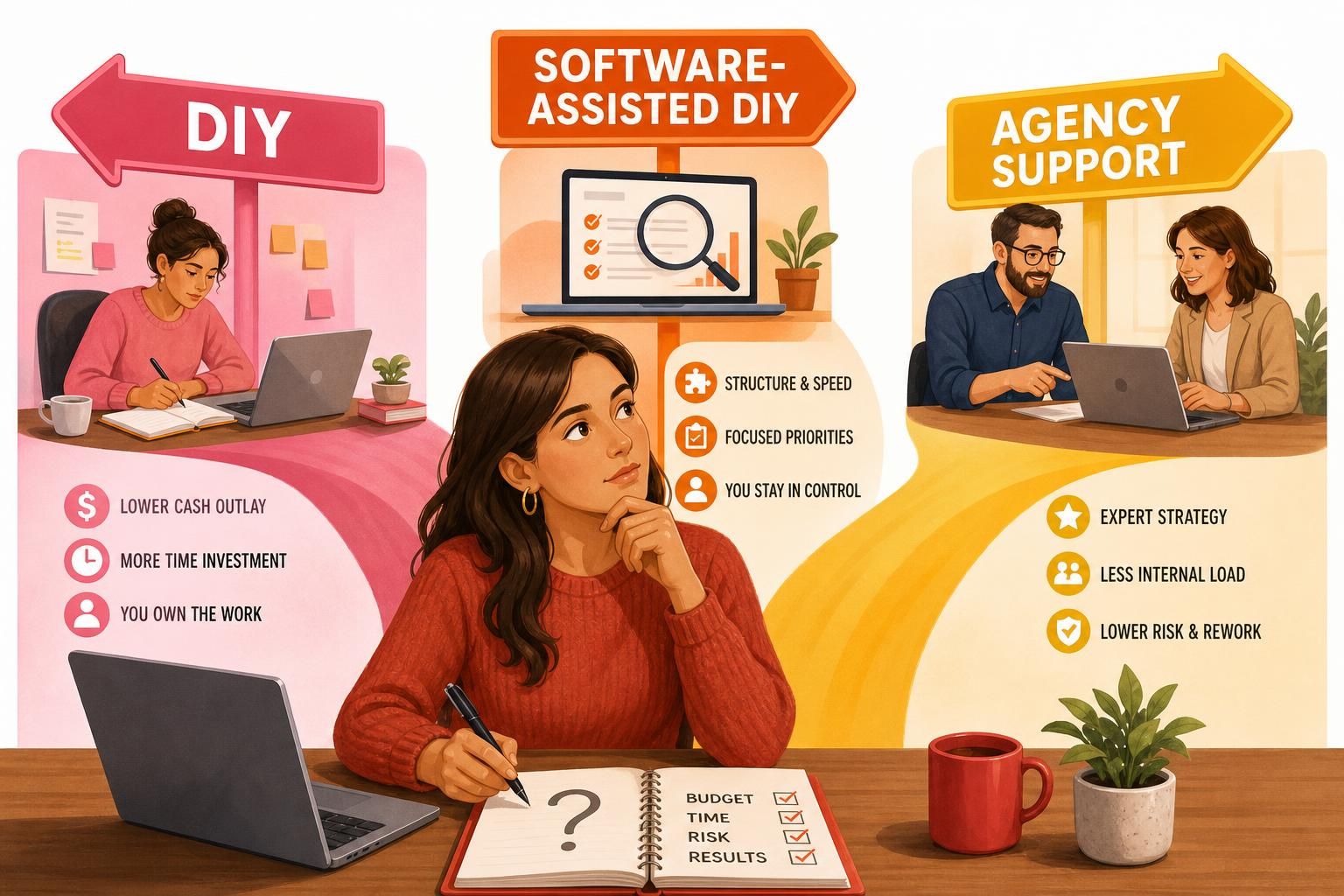
Choose DIY if your site is small, the changes are mostly content-focused, and your team can actually keep up with revisions. Choose agency support if the site is business-critical, technically complex, or difficult to coordinate internally. Choose software-assisted DIY if you want structure and speed without paying for a fully managed service. In budget terms, the cheapest option on paper is not always the cheapest option in practice.
Who this guide is for
This guide is for founders, in-house marketers, freelancers, and small teams deciding whether to build AI search work internally or outsource part of it. The outcome you want is not simply “doing AI search”; it is improving the right pages at a cost and pace your team can sustain.
Why the decision feels tricky
AI search optimization touches content quality, schema, site structure, trust signals, and page clarity. That means the expense is not only a subscription fee or agency invoice. It also includes time, technical setup, internal review, and the cost of mistakes. For a practical readiness framework, see how to audit a website for AI visibility.
Fundamentals
What the three options actually mean
DIY means your team handles the research, edits, publishing, and follow-up. Software-assisted DIY means a tool helps diagnose or organize the work, but your team still decides what to change and what to leave alone. Agency support means an outside specialist plans and executes some or all of the work, usually with less internal effort and more external coordination.
These labels matter because a low subscription price can still create expensive cleanup work, while a higher retainer can be justified if it replaces repeated internal labor or reduces risk on a site with more moving parts.
The costs beyond the sticker price
When people compare budgets, they often stop at monthly fees. In practice, total cost usually includes four more buckets:
- Time cost: research, meetings, revisions, and approvals.
- Technical cost: schema implementation, CMS edits, developer help, or QA.
- Opportunity cost: other priorities delayed while AI search work gets attention.
- Error cost: rework after incomplete, inconsistent, or poorly prioritized changes.
If your team already has strong content and technical skills, DIY can be efficient. If not, the hidden cost can exceed the visible fee.
What software can and cannot replace
Tools can speed up audits, outlines, and implementation checklists. They do not remove the need for judgment. A tool may suggest adding schema or rewriting a page, but it cannot decide whether that page should exist, whether the offer is clear, or whether the page is worth prioritizing. Human review still matters, especially when budget is limited and every task should earn its place.
If you want to understand structured data’s role in that judgment, schema markup for AI search: what matters and what does not explains the difference between useful basics and overreach. For content clarity, AI search content strategy: how to write pages that answer questions clearly covers the writing side of the equation.
Main Process / Strategies
A simple framework for comparing the paths
Start by scoring your situation in four areas: volume, complexity, speed, and internal capacity. Volume means how many pages or locations need work. Complexity means how technical the changes are. Speed means how quickly the work needs to go live. Internal capacity means whether someone on your team can own the process from start to finish.

A practical rule of thumb:
- Low volume + low complexity + available internal help: DIY is often reasonable.
- Moderate volume + some technical gaps: software-assisted DIY may be the best balance.
- High volume + high stakes + limited internal expertise: agency support may be the safer fit.
Worked example: a local service business
Example: A two-location dental practice wants better visibility for service pages, FAQs, and location details. The owner can approve content, but no one on staff is comfortable editing schema or auditing page structure. In that case, pure DIY may create delays. A software-assisted workflow could help identify the pages, draft the needed edits, and organize priorities, while a developer or agency handles the technical implementation. The budget may be lower than full-service management, but the team still gets help where it matters most.
Worked example: a small SaaS team
Example: A SaaS company has one content lead, one developer, and a clear editorial process. That team may not need a full agency retainer if it can use a tool to speed audits and create a task list. In this setup, DIY plus software can be efficient because the team already controls content and deployment. The main risk is not just labor cost; it is letting the work expand until it starts crowding out other priorities.
How to estimate total effort before you commit
A useful budget test is to ask: if we paid only for the tool or only for the agency, what internal work would still remain? For many teams, the answer is a lot. You may still need to rewrite pages, align offers, coordinate approvals, update navigation, or test changes after deployment. If that follow-up work will not be done, the apparent savings may be false savings.
Another useful test is to count decision points. Each time a page requires a strategic choice—what to say, which page to prioritize, how technical the fix should be—workload rises. If your team is already overloaded, agency help can reduce friction. If your team wants control and already has the skill, DIY may be more cost-effective.
Where SerpSling AI Lite fits
For teams that want more structure than manual DIY but are not ready for a fully managed arrangement, SerpSling AI Lite is positioned as a front-end tool for auditing and organizing AI search work. That kind of middle path can be attractive when the budget is limited and the main goal is to reduce guesswork rather than outsource everything. If you want to evaluate the front-end offer itself, see the SerpSling AI Lite option.
How to decide by business type
Some businesses tend to do well with DIY or software-assisted DIY because the work is repetitive and the team already understands the content. Others are better candidates for agency support because the consequences of poor execution are higher.
- More likely to manage DIY successfully: small content sites, experienced marketers, lean SaaS teams, and agencies building internal systems.
- More likely to benefit from agency support: multi-location businesses, reputation-sensitive firms, and teams with no internal content or technical owner.
- Often best with a hybrid: businesses that need strategy plus execution help, but want to keep some control in-house.
For a broader budgeting perspective, DIY AI search vs agency support: how to decide what fits your budget belongs alongside agency-versus-internal decision guides when your team needs an operating model, not just a one-off tactic.
FAQs, Mistakes & Expert Insights
Common mistake: comparing only monthly fees
The biggest budgeting error is comparing a tool subscription with an agency retainer and assuming that tells the whole story. It does not. A lower monthly fee can hide hours of internal labor, while a higher fee can reduce total spend if it replaces repeated revisions, developer back-and-forth, and missed opportunities. The better question is: what does each path require from the rest of the team?
Common mistake: assuming software removes the need for judgment
Automation can organize the work, but it cannot make every strategic decision. Someone still has to choose what to fix first, how to phrase the offer, and whether a page is actually useful. Without that judgment, output may look active without becoming effective.
Common mistake: hiring too early or too late
Some businesses hire an agency before they know what they need, which can waste budget on discovery they could have clarified internally. Others wait too long and lose months trying to manage a complex site with limited capacity. A better move is to define scope first: how many pages, what kind of changes, who approves them, and what success would look like.
Nuanced insight: budget fit is not just about size
Small businesses do not automatically need DIY, and larger businesses do not automatically need agencies. A small team with strong internal capability may do very well with software-assisted DIY. A larger business with many stakeholders may still need support to avoid slow approvals and inconsistent execution. Fit depends on operational maturity as much as company size.
Nuanced insight: clarity beats complexity
AI search rewards pages that are understandable, specific, and easy to evaluate. That means a simple, well-maintained page can outperform a more complicated one that is harder to keep current. This is one reason some teams benefit from a focused workflow instead of a sprawling service package. If the content strategy itself is weak, no budget option will fully compensate.
Five practical questions to ask before you spend
1. Who will own the work after the first round? If no one owns ongoing updates, even a good start can stall.
2. How technical are the required changes? The more technical the site, the more value agency support can add.
3. How many pages actually matter? A narrow priority set is easier to handle in-house than a broad site-wide project.
4. What is the cost of delay? If waiting costs leads or reputation, faster support may be worth more than a cheaper setup.
5. Do you need strategy, execution, or both? Many budget conflicts come from buying the wrong mix.
FAQ 1: When is DIY AI search the smartest budget choice?
DIY is usually the smartest choice when your site is small, your team already creates and edits content, and the needed changes are not heavily technical. It works best when someone will actually own the follow-up work. If nobody has time to maintain the pages after launch, the savings can disappear quickly.
FAQ 2: What hidden costs should I expect beyond a tool subscription?
The main hidden costs are internal time, technical implementation, revision cycles, and opportunity cost. Even a low-cost tool can create extra work if your team still has to rewrite pages, coordinate approvals, or fix implementation issues. Budget for the work around the tool, not just the tool itself.
FAQ 3: When does agency support make more sense than doing it myself?
Agency support makes more sense when the site is high stakes, the changes are complex, or your team lacks the capacity to manage the process well. It can also help when speed matters and you want fewer internal decision points. The key question is whether the agency reduces total workload, not just adds another line item.
FAQ 4: Is software-assisted DIY a real middle ground or just a compromise?
It can be a real middle ground when the tool helps you diagnose, prioritize, and organize work while your team keeps control of decisions. That approach is often practical for businesses that have some internal talent but not enough bandwidth for a fully managed service. It becomes a poor fit only if no one inside the business is ready to review and apply the recommendations.
FAQ 5: How do I know if my business should stay in-house or outsource?
Look at volume, complexity, speed, and internal capacity. If the work is limited and your team can handle it, staying in-house is often efficient. If the work is broad, technical, or urgent, outsourcing or agency help may be safer. The decision is less about business size and more about whether your team can execute consistently without stalling.
When is DIY AI search the smartest budget choice?
DIY is usually the smartest choice when your site is small, your team already creates and edits content, and the needed changes are not heavily technical. It works best when someone will actually own the follow-up work. If nobody has time to maintain the pages after launch, the savings can disappear quickly.
What hidden costs should I expect beyond a tool subscription?
The main hidden costs are internal time, technical implementation, revision cycles, and opportunity cost. Even a low-cost tool can create extra work if your team still has to rewrite pages, coordinate approvals, or fix implementation issues. Budget for the work around the tool, not just the tool itself.
When does agency support make more sense than doing it myself?
Agency support makes more sense when the site is high stakes, the changes are complex, or your team lacks the capacity to manage the process well. It can also help when speed matters and you want fewer internal decision points. The key question is whether the agency reduces total workload, not just adds another line item.
Is software-assisted DIY a real middle ground or just a compromise?
It can be a real middle ground when the tool helps you diagnose, prioritize, and organize work while your team keeps control of decisions. That approach is often practical for businesses that have some internal talent but not enough bandwidth for a fully managed service. It becomes a poor fit only if no one inside the business is ready to review and apply the recommendations.
How do I know if my business should stay in-house or outsource?
Look at volume, complexity, speed, and internal capacity. If the work is limited and your team can handle it, staying in-house is often efficient. If the work is broad, technical, or urgent, outsourcing or agency help may be safer. The decision is less about business size and more about whether your team can execute consistently without stalling.
Summary & Next Steps
The budget-fit framework
If you want full control and have the time, DIY can work. If you want to reduce manual work without committing to a full retainer, software-assisted DIY is often the middle ground. If the site is complex, the stakes are high, or your team is already stretched, agency support may be the better use of budget.
The best decision is usually the one that matches your team’s real capacity, not the one that sounds most ambitious. Start by identifying the pages that matter most, the skills you already have, and the work you would still need help with after any subscription or retainer starts.
What to do next
Read the supporting guides on audits, schema, and content structure if you want to estimate effort more accurately. Then choose the path that leaves you with a sustainable process, not just a short-term fix. If you are evaluating a software-first approach, you can also review the SerpSling AI Lite front-end offer as one possible tool in that middle tier.
Continue with a related guide
For commercial investigation, read SerpSling AI Lite review: is the front-end AI search optimization tool worth it?.

[…] a broader decision framework on tools versus people, DIY AI search vs agency support can help frame the […]