

Commission disclosure: This guide includes a commissionable product link. The goal here is to help you build a practical ad-creative system, not to pressure a purchase.
If you are trying to produce ads without a large design or copy team, the core challenge is usually not making one decent ad. It is turning one offer into a repeatable process for multiple platforms without wasting time, creating near-duplicates, or losing brand consistency. A lean ad creative workflow solves that by moving from offer clarity to angles, assets, drafts, and review in a sequence you can repeat week after week.
This article gives you a tool-agnostic workflow you can use right away. Where relevant, it also shows where Adstorm Elite may fit if you want to speed up draft generation. For the broader product decision, the pillar review covers that perspective in more detail. This guide stays focused on process.
Direct Answer & Introduction
The shortest useful answer
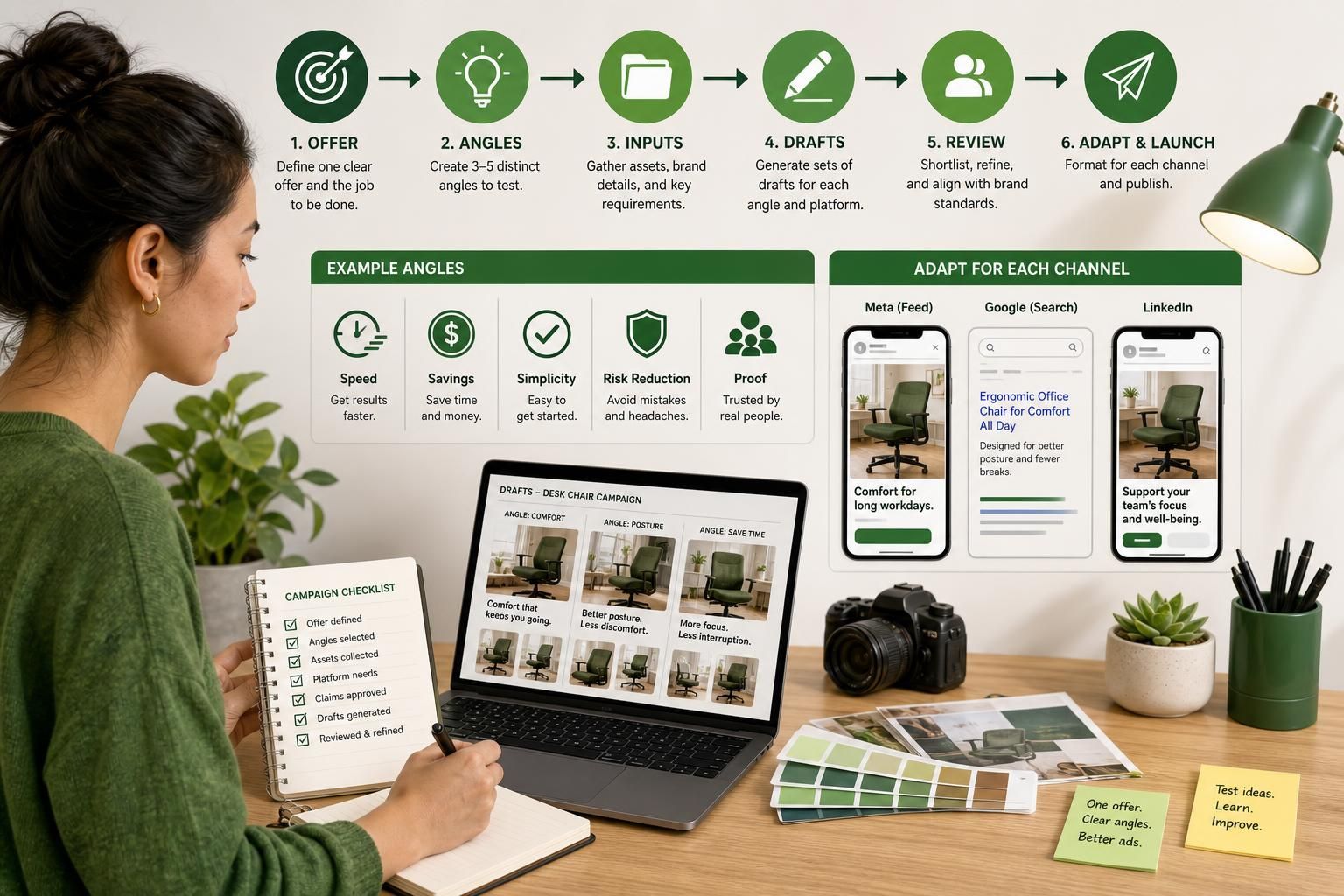
A strong ad creative workflow for solopreneurs and small agencies starts with one clear offer, turns that offer into a few testable angles, prepares the assets once, then generates channel-specific drafts and adapts them into platform-ready versions. The goal is not volume for its own sake. It is to produce enough variation to test ideas while keeping brand consistency and review time under control.
Who this is for
This approach is best for solopreneurs, freelancers, and small agencies that need a predictable way to make ads for clients or their own business. It is especially useful when you do not have dedicated copywriters, designers, and media buyers for every campaign.
What outcome to expect
If you follow a lean workflow, you should be able to move from a brief to multiple ad drafts without starting from scratch each time. That can reduce bottlenecks, make feedback easier, and help you keep your creative library organized enough to reuse later.
Fundamentals
What an ad creative workflow actually is
An ad creative workflow is the repeatable sequence you use to go from business goal to finished creative. In practical terms, it includes the offer, audience assumption, angle selection, asset preparation, draft creation, review, and versioning. A good workflow reduces blank-page time and avoids the common trap of making random assets without a plan.
Core terms to know
Offer: the product, service, or promotion you want to advertise. Angle: the specific reason someone should care, such as speed, savings, convenience, or trust. Creative variation: a different combination of headline, visual, and call to action. Platform adaptation: changing one concept so it fits the format and behavior of a channel like Meta ads, Google, TikTok, or LinkedIn.
Why lean teams need structure
Large teams can absorb inefficiency because they have more people and more time. Smaller teams cannot. When you are short on capacity, structure matters because every unnecessary revision costs momentum. A clear workflow also makes it easier to delegate pieces of the work, even if only to yourself across different time blocks.
Where AI fits, and where it does not
AI can help with brainstorming, draft generation, summaries, and formatting. It does not replace judgment about the offer, the audience, or what your brand should avoid saying. It is best used as an assistant that speeds up the production stage after the strategy is already clear.
Main Process / Strategies
1) Start with one offer and one job-to-be-done
Do not begin by asking for ads. Begin by defining the job the ad must do. Is it meant to get demo bookings, ecommerce clicks, leads, or retargeting conversions? Then narrow to one offer. If the offer is too broad, your creative ideas will sprawl and your tests will become noisy.

Example: a local bookkeeping service may have several services, but the ad workflow should start with one offer, such as catch up three months of books in one week, rather than all accounting services.
2) Turn the offer into 3 to 5 angles
Once the offer is clear, create a short list of angles. For example, speed, cost control, simplicity, risk reduction, or proof. These are not final ads yet; they are creative hypotheses. A lean workflow uses a small number of distinct angles instead of twenty versions of the same idea.
Example: if you sell a course, you might test save time, avoid mistakes, and get started faster as separate angles. Each one can support different hooks, visuals, and headlines.
3) Organise your inputs before generation
Before you generate anything, gather the inputs that will keep the outputs useful: brand name, product description, offer details, target platform, mandatory wording, approved claims, visual references, and any assets you already own. If you skip this step, AI drafts may still be usable, but they will often need more cleanup.
For small teams, a simple intake checklist works well. You can keep it in a document, spreadsheet, or project board. The point is to collect the same information every time so you are not reinventing your brief on each campaign.
4) Use platform fit as a filter, not an afterthought
One of the biggest workflow mistakes is writing a single master ad and forcing it everywhere. Different channels reward different creative shapes. Search-style ads often need concise intent-led copy, while social placements may benefit from more visual narrative and faster hooks. Instead of writing one ad and hoping it adapts, start with the channel in mind.
Practical rule: keep the core promise stable, but allow the headline, visual density, and call to action to change by platform.
5) Generate drafts in sets, not as isolated one-offs
When you generate drafts, aim for sets of related variations. A set might include one angle with three hook lines, two visual treatments, and two call-to-action options. This makes review easier because you are comparing structured alternatives instead of unrelated fragments.
If you use a tool such as Adstorm Elite, the practical question is not whether it can make a lot of drafts. The more useful question is whether it helps you keep each draft tied to one offer, one angle, and one platform requirement. That is what makes outputs more usable in a real workflow.
6) Reuse without creating sameness
Reusing creative is efficient, but careless reuse makes every ad look identical. The fix is to reuse the strategic layer while changing the presentation layer. Keep the offer and the angle, but vary the hook, image focus, caption length, order of benefits, or proof point.
Example: one campaign could keep the same offer and audience but switch from a save time angle to a reduce mistakes angle. The ads are related, but they do not feel like copies.
7) Keep a lightweight review loop
Before publishing, check three things: does the ad match the channel, does it clearly support the offer, and is the language aligned with the brand’s standards? This review loop should be short. If your approval process is too heavy, the workflow loses its value. Small teams usually need a practical gate, not a bureaucracy.
Worked example: one product, two channels
Imagine a compact home-office chair brand targeting remote workers. The goal is direct-response traffic to a product page.
Step 1: Offer. One chair, one primary promise: more comfort for long desk sessions.
Step 2: Angles. Angle A could be comfort during long workdays. Angle B could be posture support and fewer breaks from discomfort.
Step 3: Inputs. You gather product photos, a concise product summary, approved claims, dimensions, and a list of existing brand colors.
Step 4: Channel adaptation. For a social platform, the creative might lead with a lifestyle image and short hook. For search-related inventory, the draft might lean on intent-based text and simpler benefit language.
Step 5: Reuse. Both versions can share the same core offer, but the social ad can use a more emotional angle, while the text-led version can be more direct.
The benefit of this approach is that one product can yield several usable ads without multiplying the number of strategic decisions you have to make.
A simple weekly cadence
A sustainable small-team cadence might look like this: Monday, review performance and pick one offer to work on. Tuesday, define angles and gather assets. Wednesday, generate drafts and shortlist the best candidates. Thursday, revise and format for channels. Friday, launch or hand off. The exact days do not matter as much as the rhythm: decide, draft, refine, publish, review.
FAQs, Mistakes & Expert Insights
Common mistakes to avoid
Making too many similar ads: More versions are not always better if they all say the same thing. A good test plan needs meaningful variation. Starting without a clear offer: If the offer is vague, the creative will be vague too. Ignoring channel differences: A concept that works in one format may fail in another if it is not adapted. Over-editing drafts: Small teams sometimes spend too long polishing weak ideas instead of replacing them with better ones.
Nuanced points people often miss
Speed is useful, but speed without review creates messy output. Reuse is efficient, but reuse without variation reduces testing value. AI can reduce labor, but it does not replace the need for a thoughtful offer and a clear audience assumption. The best results usually come from combining structured inputs with disciplined editing rather than asking a tool to do everything blindly.
How to judge whether your workflow is working
A good workflow should make campaigns easier to launch, easier to revise, and easier to explain to a client or teammate. If you spend less time assembling the same basics every week, that is a sign the process is improving. If the creative still feels random, the issue is usually upstream: the offer, the angle set, or the asset organization.
FAQ: How many ad variations do I actually need?
You do not need dozens of nearly identical ads to learn something useful. A small set of clearly different variations is usually more informative than a large batch of clones. Start with a few angles and make sure each one represents a genuinely different reason to act.
FAQ: Should I create the visual or the copy first?
Either can work, but small teams often move faster when they decide the angle first. The angle gives both the copy and the visual a shared purpose. Once the angle is clear, you can draft headlines and choose imagery that supports the same message.
FAQ: Can I reuse one ad across multiple platforms?
You can reuse the underlying idea, but you should adapt the format, length, and emphasis for each platform. A direct copy-paste approach often underperforms because each placement has different expectations and user behavior.
FAQ: What if my team only has a few hours per week?
Use a smaller cycle. Pick one offer, one or two angles, and one primary channel. A narrow workflow is more sustainable than a broad one when capacity is limited. The goal is steady production, not perfection.
FAQ: How do I avoid making every ad look the same?
Keep the strategic message consistent but change the framing. Rotate hooks, visuals, proof points, and calls to action. You can also vary the problem statement or the outcome being emphasized while keeping the same offer.
How many ad variations do I actually need?
You do not need dozens of nearly identical ads to learn something useful. A small set of clearly different variations is usually more informative than a large batch of clones. Start with a few angles and make sure each one represents a genuinely different reason to act.
Should I create the visual or the copy first?
Either can work, but small teams often move faster when they decide the angle first. The angle gives both the copy and the visual a shared purpose. Once the angle is clear, you can draft headlines and choose imagery that supports the same message.
Can I reuse one ad across multiple platforms?
You can reuse the underlying idea, but you should adapt the format, length, and emphasis for each platform. A direct copy-paste approach often underperforms because each placement has different expectations and user behavior.
What if my team only has a few hours per week?
Use a smaller cycle. Pick one offer, one or two angles, and one primary channel. A narrow workflow is more sustainable than a broad one when capacity is limited. The goal is steady production, not perfection.
How do I avoid making every ad look the same?
Keep the strategic message consistent but change the framing. Rotate hooks, visuals, proof points, and calls to action. You can also vary the problem statement or the outcome being emphasized while keeping the same offer.
Summary & Next Steps
What to do next
The simplest path is to build one repeatable workflow around one offer, a short angle list, organised assets, and platform-specific drafts. That framework is enough for most solopreneurs and small agencies to move faster without losing control.
If you want to explore a tool that may help accelerate the draft stage, you can review Adstorm Elite alongside the pillar review and the supporting articles on evaluation, AI ad output, cost estimation, and common mistakes. Those pieces work best together: one explains the tool decision, while this guide explains the process.
For a broader workflow perspective, see what AI ad creative tools actually do, how to evaluate an AI ad creator before you buy, how to estimate the real cost of an AI ad tool, and common mistakes when using AI for ads. The main point is simple: a better workflow beats a busier workflow.
Continue with a related guide
For commercial investigation, read Adstorm Elite Review: Is This AI Ad Creator Worth It for Solo Marketers and Small Teams?.

[…] you want a deeper buyer lens, return to the main review pillar; if you want process guidance, the workflow guide is the natural next […]