

Commission disclosure: This guide includes one contextual link to a related commercial page for readers who want to explore a tool-based workflow, but the main purpose here is education: understanding what AI search optimization is, how it differs from classic SEO, and what to do first.
If you are hearing terms like AI search, answer engines, or AEO and wondering whether this is just SEO with a new label, the short answer is that it overlaps with SEO but adds a new job: making your content easy for AI-powered systems to understand, summarize, and potentially use in an answer. This guide is for beginners, site owners, marketers, and freelancers who want a practical, jargon-free starting point. The outcome is simple: you should leave with a clear definition, a realistic view of what the systems can do, and a sensible first learning path.
Direct Answer & Introduction
What AI search optimization means
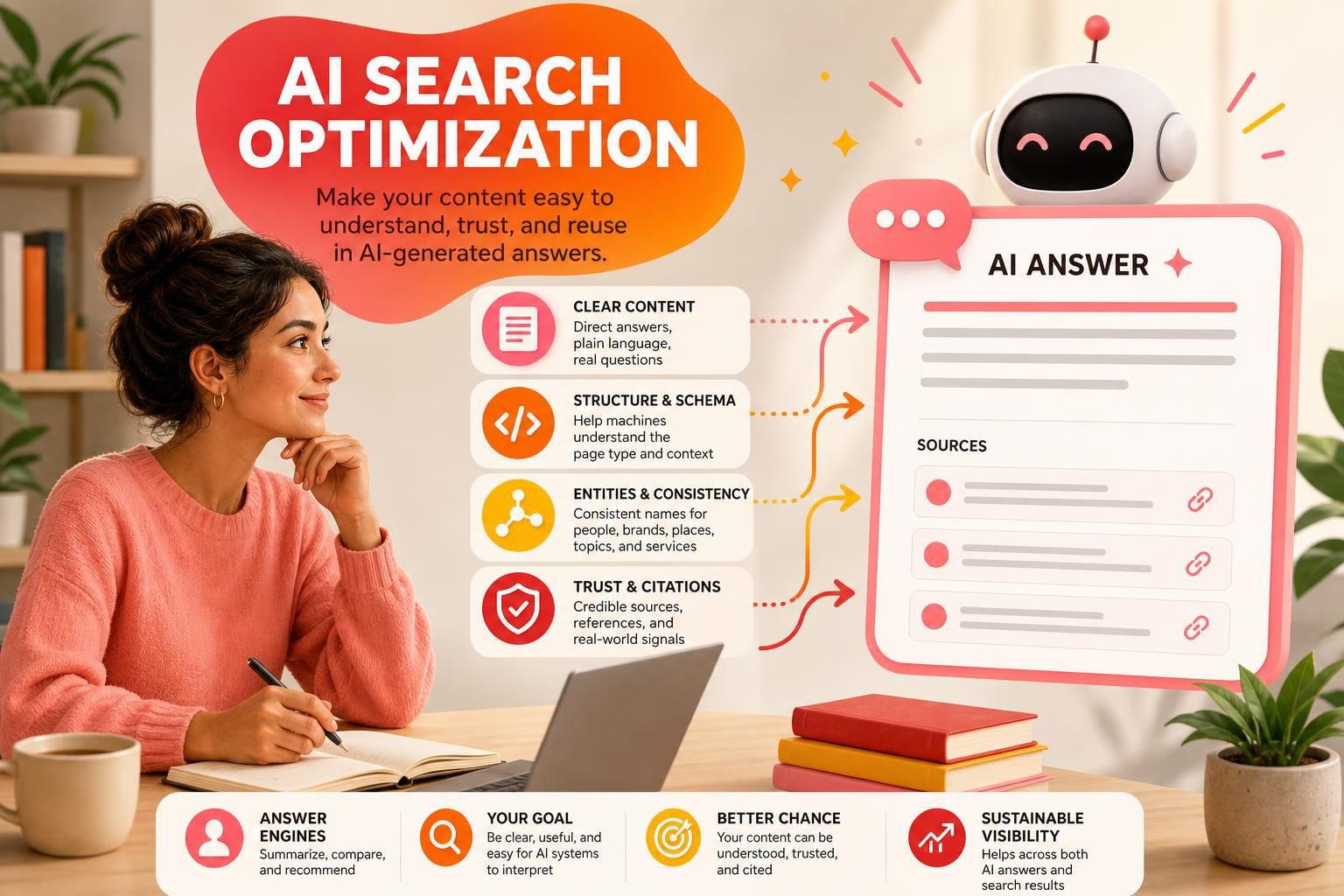
AI search optimization is the practice of shaping content so answer engines and AI-assisted search tools can understand it well enough to reuse it in a response. Classic search engines mostly help people find pages. AI search systems more often try to produce a direct answer, sometimes by combining information from several sources. That changes the work: you are not only trying to rank a page, but also trying to make it clear, structured, and credible enough to be selected as part of an answer.
For beginners, the main problem is confusion. People see AI-generated answers and assume the rules must be completely different. The reality is more practical: many of the basics still matter, but they are now filtered through machine readability, topic clarity, and source trust.
Who this is for
This guide is meant for anyone starting from zero who wants to understand the topic before spending money on tools, outsourcing, or a bigger content project. If you manage a website, publish articles, run a local business, or work on client sites, learning the basics can help you judge whether a page is easy for an answer system to interpret.
Fundamentals
AI search, answer engines, and classic search
Traditional search engines usually return a list of links. AI search and answer engines often synthesize a response, which may include citations, summaries, comparisons, or recommendations. The important difference is not simply where the answer appears. It is how the system reads, compresses, and recombines information. That is why a page that is easy for humans to scan is not always easy for a model to classify.
Core terms: AEO, schema, entities, and citations
AEO usually stands for answer engine optimization. It means making content easier for systems that generate answers rather than only search results. Schema markup is structured data added to a page so machines can identify things like an article, organization, product, service, or FAQ more reliably. Entities are the distinct people, brands, places, and topics a system can recognize. Citations are the source mentions or references an answer engine may show when it uses material from a page or supports a response with outside sources.
The practical idea is straightforward: the clearer your page is about what it covers, who it is for, and what real-world thing it refers to, the easier it becomes to interpret. That does not guarantee selection, but it reduces ambiguity.
Why these terms matter together
A page can be well-written and still be hard for AI systems to use if the topic is fuzzy, the structure is scattered, or the key entities are inconsistent. Schema can help identify the page type. Clear wording helps establish the topic. Entity consistency helps the system understand what brand, place, or service is being discussed. Citations matter because some answer systems prefer or expose source-backed information more visibly than others.
For a broader overview of the topic itself, you can also read the product review pillar, which covers the commercial angle separately. For a practical site-level diagnostic approach, see how to audit a website for AI visibility.
Main Process / Strategies
How an answer engine might choose sources
Imagine a user asks, “What is AI search optimization?” An answer engine may look for pages that define the term clearly, explain related concepts, and do so in a way that is easy to parse. A page with a direct definition near the top, clear headings, and consistent terminology has a better chance of being understood than one that hides the answer in a long intro.

Example: if one page says, “AI search is changing the internet,” and another says, “AI search optimization is the practice of structuring content so answer engines can identify the topic, trust the source, and reuse the page in a response,” the second page gives the system a much cleaner signal about what the page is for. The first may be catchy, but it is vague.
What to do first on your own site
Start with clarity before tools. Write a one-paragraph definition of the page’s topic near the top. Use headings that reflect the questions readers actually ask. Keep your wording plain and specific. If a page is about a local service, product, or expert topic, make sure the name, service description, and location are consistent across the page and across the site.
Then check whether each page has one obvious purpose. A narrow page that answers one question well is often easier for systems to understand than a broad page that tries to cover too much at once. This is especially true for beginner educational content, where the goal is understanding rather than persuasion.
Where schema and entities fit
Schema is useful because it adds machine-readable context. It can tell a system whether a page is an article, FAQ, organization page, local business page, or something else. It does not rescue weak content, but it can reduce confusion. Entities matter because AI systems often need to understand the real-world things your page is about: a brand, a location, a person, a service, or a topic.
If you want a deeper look at how that works in practice, schema markup for AI search explains what matters and what does not. If your goal is to write pages that are easier for machines and people to understand, AI search content strategy shows how to structure answers clearly.
What AI search can do, and what it cannot reliably do
AI search can summarize, compare, and recommend based on available information. It can also miss nuance, overstate confidence, or prefer the most accessible source rather than the best one. That means beginners should not treat AI search as a perfectly stable or fully transparent ranking system.
It is also important to avoid expecting immediate results. Even if a page becomes easier to understand, visibility can still vary depending on the query, the model, the market, and how current the information is. The sensible approach is to optimize for clarity, usefulness, and consistency first, then evaluate over time.
If you are weighing whether to handle this yourself or get outside help, DIY AI search vs agency support is the best comparison point in the cluster.
FAQs, Mistakes & Expert Insights
Common beginner mistakes
The biggest mistake is treating AI search optimization like a trick. It is much more basic than that: pages need to answer real questions clearly. Another common mistake is leading with a long, vague introduction and burying the actual answer. Humans get impatient with that, and machine systems often benefit from directness too.
Beginners also over-focus on a single signal. Schema matters, but it is only one part of the picture. Good wording, clear structure, consistent entities, and trustworthy page purpose all matter. A page with perfect markup but thin explanation is still weak. A useful page with no structure may still be overlooked because it is harder to parse.
Misconceptions about AI visibility
One misconception is that answer engines always choose the “best” source. In reality, they may choose the clearest, most available, most contextually relevant, or most machine-readable source. Another misconception is that AI search replaces SEO entirely. A safer view is that it adds a new layer on top of search behavior.
Another misconception is that a tool can solve everything automatically. If a vendor promises guaranteed visibility, treat that as a marketing claim rather than a fact. Outcomes depend on the quality of the site, the topic, the competition, and how well the content itself supports the task.
Nuanced insights worth keeping in mind
One useful insight from the supplied material around the commercial tool page is that the workflow emphasis is consistent: diagnose what is unclear, improve structure, and make the page easier for systems to interpret. That part is sensible. The performance claims attached to the promotion, however, should not be treated as proof of results. They are marketing language, not evidence of what every site will experience.
Another practical point is that beginner work should not start with advanced optimization before the basics are in place. If your page does not clearly explain its topic, advanced schema and automation will not compensate for the lack of clarity. Start with the content, then add structure, then refine the supporting signals.
Five useful Q&As
1. Is AI search optimization the same as SEO? No. It overlaps with SEO, but it focuses more on how answer engines interpret and reuse content than on classic blue-link rankings alone.
2. Do I need schema on every page? Not necessarily. Structured data is especially helpful on pages where machines need extra context, such as articles, services, products, or FAQs.
3. Can AI search guarantee traffic? No. It may improve discoverability, but it cannot guarantee rankings, citations, or traffic volume.
4. What kind of content works best? Pages that define a topic clearly, answer a real question directly, and stay consistent about entities and facts are usually easier to interpret.
5. Should beginners start with tools or content? Start with content and structure. Tools can support the process, but they do not replace clear writing or topic focus.
Is AI search optimization the same as SEO?
No. It overlaps with SEO, but it focuses more on how answer engines interpret and reuse content than on classic blue-link rankings alone.
Do I need schema on every page?
Not necessarily. Structured data is especially helpful on pages where machines need extra context, such as articles, services, products, or FAQs.
Can AI search guarantee traffic?
No. It may improve discoverability, but it cannot guarantee rankings, citations, or traffic volume.
What kind of content works best?
Pages that define a topic clearly, answer a real question directly, and stay consistent about entities and facts are usually easier to interpret.
Should beginners start with tools or content?
Start with content and structure. Tools can support the process, but they do not replace clear writing or topic focus.
Summary & Next Steps
Your first learning path
If you are new to the topic, begin with three habits: define the page topic in plain language, organize the page around real questions, and check whether your facts are consistent across the site. Once that is in place, learn enough schema to support clarity rather than chase shortcuts.
A simple workflow works best: understand the topic, audit the page, improve structure, and then review how the content supports entities and trust signals. That approach is easier to maintain and more likely to help across both search and answer systems.
What to read next
To keep building your understanding, move from this beginner overview to a site audit, then to schema basics, and then to content strategy. Those three topics form the practical foundation.
If you want to see how a commercial tool fits into that workflow, the SerpSling AI Lite page covers the product side, while this guide stays focused on the concepts. For the broader learning path, continue with site audit checklist, schema basics, content strategy, and DIY vs agency support.

[…] deeper background, see the supporting guides on what AI search optimization means, which schema markup matters, how to write answer-first content, and when DIY or agency support […]
[…] you want a plain-English starting point for what AI search optimization means, the lite offer may be a reasonable place to begin. If you already have a mature SEO stack, the key […]
[…] answer, support it with specific reasoning, and remain easy to scan. For broader context, see what AI search optimization means and, for page-level diagnostics, how to audit a website for AI […]
[…] behind this work, see how to audit a website for AI visibility, AI search content strategy, and what AI search optimization means. If you are weighing a do-it-yourself path against outside support, DIY AI search vs agency support […]