

Quick answer
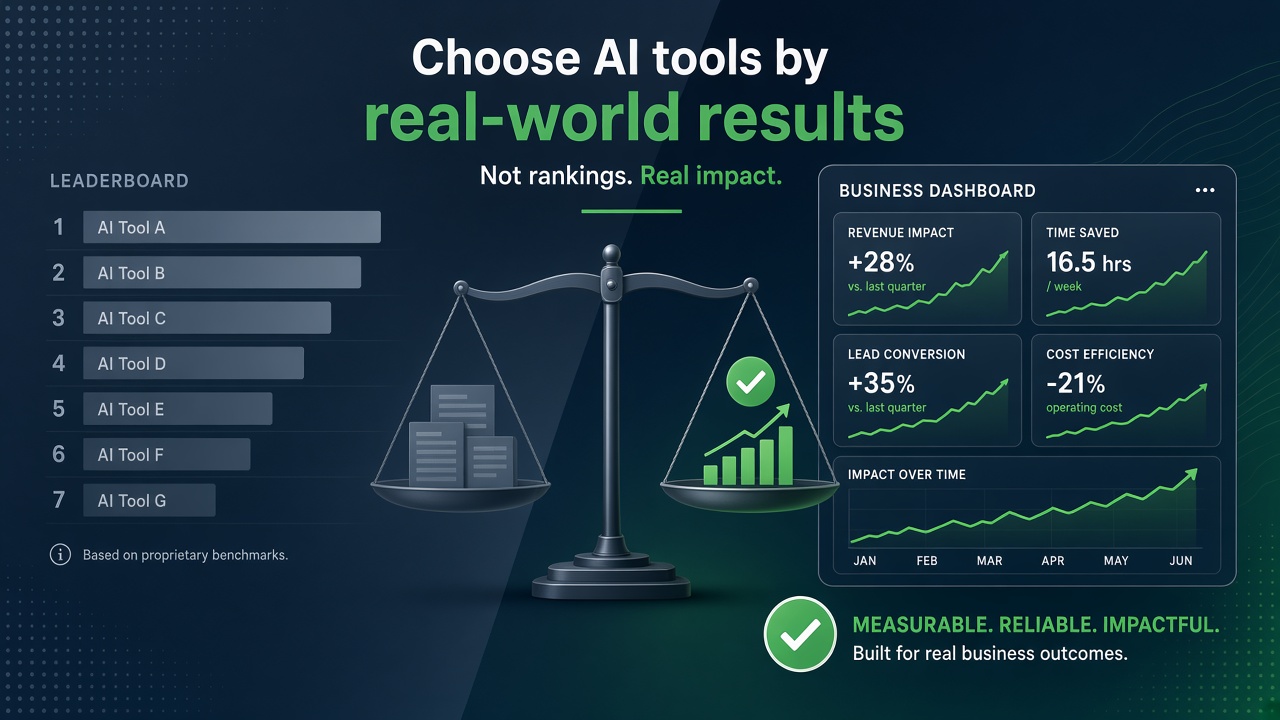
To choose an AI tool for your business, ignore leaderboard rank as your main signal. Instead, test two or three tools on your own real tasks, measure time saved, error rate and cost per finished job, and pick the one your team actually uses well. A model that tops a benchmark can still disappoint in practice.
Key takeaways
- A top leaderboard score does not tell you whether a tool works on your tasks
- Launch claims and independent tests often disagree
- Measure time saved, fixes needed and cost per finished job
- Ignore unreleased or rumoured models until you can test them
In this guide
- Watch: the source video
- Why are AI benchmarks a poor guide to choosing a tool?
- What matters more than benchmarks?
- How do benchmarks compare with real-world testing?
- How do you choose an AI tool based on real-world results?
- What should you ignore when a new model launches?
- What qualities make an AI tool worth keeping?
- Frequently asked questions
- The bottom line
🛠️ Practical guides
Ready to put this into practice? These step-by-step guides answer two common follow-up questions:
Every week brings a new AI model claiming the top spot on some leaderboard. If you run a small business, a blog or an affiliate site, it is tempting to chase whichever one is “number one”. This post explains why that is a poor strategy, and what to measure instead.
If you want a full buying checklist, we already have one: how to evaluate an AI product before you buy.
This article focuses on one specific trap: trusting benchmarks over real-world results.
Watch: the source video
What this video covers: Nate B Jones argues that benchmarks matter less than customer obsession and explains what that means for businesses using AI.
Video: Nate B Jones (@NateBJones) argues that customer obsession, not leaderboards, is the benchmark that matters. We also reference this hands-on test of Meta's Muse Wonder by WorldofAI (@intheworldofai).
Why are AI benchmarks a poor guide to choosing a tool?
Benchmarks measure what a model can do on a fixed test. Your business needs to know what a tool will do on your messy, real work. Those are different questions.
A top score does not mean you can use it
Nate B Jones' example is Google's Gemini Argon, which sits at the top of a leaderboard while almost nobody can actually use it yet. If you cannot put it in front of your workflow, its rank tells you nothing about whether it will help you.
Claims and independent tests often disagree
💡 Tip: When a vendor claims a model is “the best”, look for at least one independent hands-on test before you rely on it.
When Meta launched Muse Wonder, it positioned the model as competing with the very best. WorldofAI's own multi-category testing ranked it seventh overall, well below those claims, and Meta's chief AI officer acknowledged the team had not trained it specifically on 3D game demos.
Others defended the model as strong for real coding work. Whoever is right, the lesson is the same: a headline claim is a starting point for testing, not a conclusion.
Benchmark settings may not match yours
As we noted in our Claude 5.5 model comparison, published scores are often run at maximum effort, which can cost far more than the settings you would use day to day.
What matters more than benchmarks?
Nate B Jones' argument is that the models are no longer the main bottleneck. The pain points in AI now mostly come from the product experience: how well a tool fits the person using it.
He gives examples from his own use:
- He counted 26 separate agent use cases in three months, from tax preparation to travel planning and school schedules
- He had an agent quietly work through more than 20,000 likes and bookmarks to build a reading list, a job that was previously too big to attempt
None of those wins came from a leaderboard. They came from using a tool repeatedly on real problems and learning where it works.
How do benchmarks compare with real-world testing?
| Question | Benchmark tells you | Real-world test tells you |
|---|---|---|
| Is it smart? | Score on a fixed academic task | Whether it gets your task right |
| Is it affordable? | Price per token, often at max effort | Cost per finished job at your settings |
| Is it reliable? | Average performance | How often your team has to fix the output |
| Will people use it? | Nothing | Adoption, friction and trust |
| Does it fit your tools? | Nothing | Integrations, access and setup effort |
How do you choose an AI tool based on real-world results?
Use this one-week trial. It complements, rather than replaces, our buying checklist.
- Pick one job. Choose a task you do every week, such as writing product round-ups or replying to affiliate enquiries. Our guide to scoring AI use cases by value, risk and reversibility helps you pick a good first candidate.
- Build a small test set. Gather 20 to 50 real examples. See our AI test set guide.
- Shortlist two or three tools. Include your current tool as the baseline.
- Run the same examples through each. Use the settings you would really use.
- Measure four numbers: minutes saved per task, outputs needing fixes, cost per finished job and how the person doing the work rated it.
- Decide and set a review date. Re-test when a big new model launches, not every time a leaderboard changes.
Run the one-week trial. Pick one weekly task, test two or three tools on it and keep the one with the lowest cost per acceptable result.
What should you ignore when a new model launches?
- “Number one on X leaderboard” headlines with no access or pricing
- Cherry-picked demos, especially flashy 3D or game demos if your work is writing or analysis
- Leaked or rumoured models. For example, there is currently a lot of speculation about upcoming models such as Fable 5.5; until they are released and testable, they are not a basis for a decision
- Pressure to switch immediately. A good tool today is still a good tool next month
🔎 Unconfirmed / rumour: Reports about upcoming models such as Fable 5.5 are unconfirmed. Treat them as speculation until the model is officially released and available to test.
For an example of evaluating a specific model calmly, see our Grok 4.7 business evaluation plan.
What qualities make an AI tool worth keeping?
Borrowing Nate B Jones' framing, look for signs that the tool's makers are obsessed with customers like you:
- It solves a clear problem for your type of business, not just a general chat box
- It improves steadily based on real use
- It is easy for non-technical team members to adopt
- It fits the tools you already use
- Its costs are predictable
Want help picking your next AI tool? Start with one weekly task and run the trial above. For more practical, evidence-led AI guides, browse Prodify Digital.
Frequently asked questions
Are AI benchmarks useless?
No. They are useful for a rough shortlist. They just should not be your deciding factor.
How long should I test an AI tool before buying?
A focused week on one real task is usually enough to see time saved, error rates and cost.
Should I switch every time a better model is released?
No. Re-test when a major release is actually available to you and relevant to your task, then switch only if your own results improve.
What is the most important metric?
Cost per finished, acceptable job. It combines quality, price and how much fixing is needed.
How do I know if a model claim is a rumour?
If the model is not officially released, documented and available for you to try, treat claims about it as speculation.
The bottom line
The next year in AI is likely to be about products, not leaderboards. Choose AI tools the same way you would hire help: give them real work, measure the results and keep the ones that make your business better.
Related posts
- How to Evaluate an AI Product Before You Buy: A Practical Checklist
- How to Score AI Use Cases by Value, Risk and Reversibility
- Build an AI Test Set Before You Change a Business Workflow

[…] between Gemini, Claude and ChatGPT? Run the same week-long trial on your real work. Our guide to how to choose an AI tool for your business shows […]
[…] guide answers one question raised by our article How to Choose an AI Tool for Your Business: Benchmarks vs Real-World Results: when a new model claims to be the best, how do you check before you believe […]
[…] guide on how to choose an AI tool for your business walks through a one-week […]
[…] up which model to use, judge it on your own tasks rather than headline results. Our guide on how to choose an AI tool for your business walks through a one-week […]
[…] AI tools for a team, re-test on your own tasks rather than chasing every launch. Our guide on how to choose an AI tool for your business shows you how to run a fair […]
[…] How to Choose an AI Tool for Your Business […]