

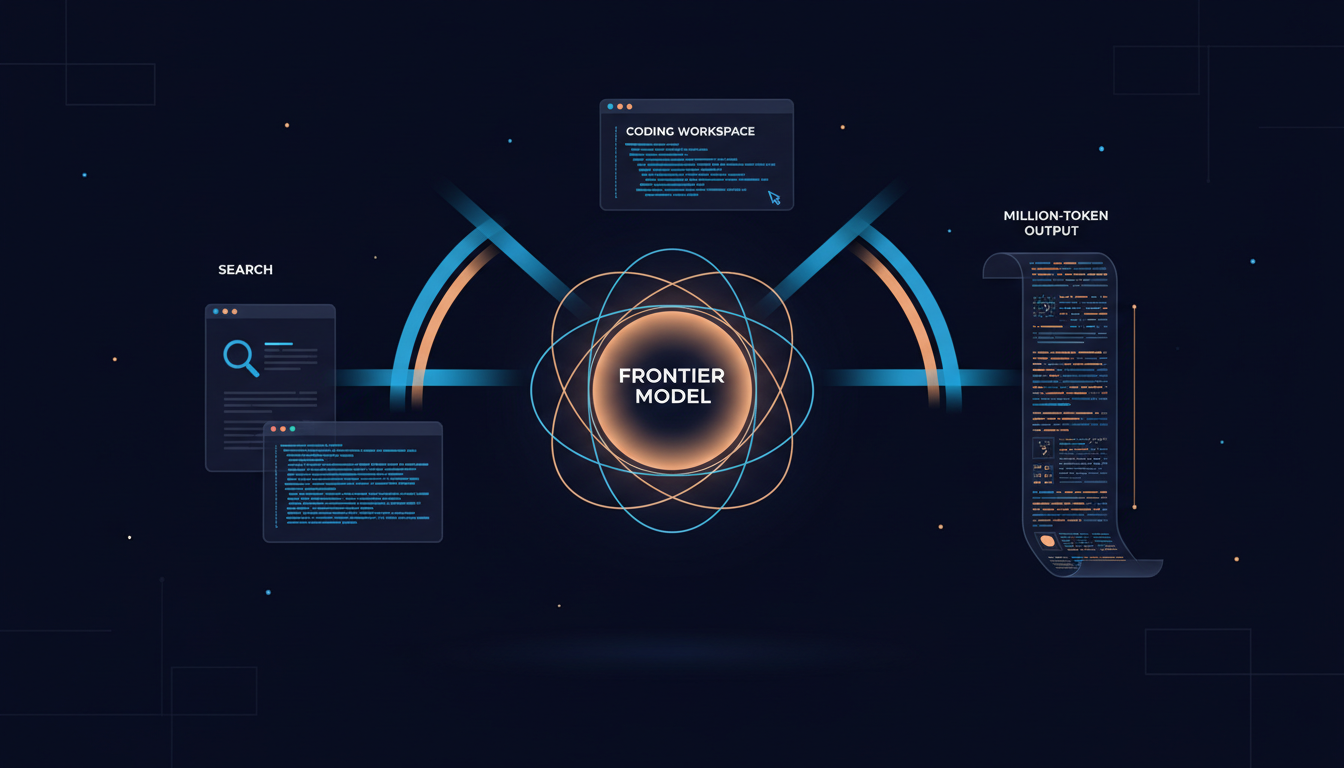
Quick answer
Gemini 4 Argon is Google’s new frontier model aimed at complex, longer-running work. Access is live for Google AI Pro and Ultra subscribers after an earlier announcement without public access. In Matt Wolfe’s hands-on review it looks competitive with Opus 5.5 and GPT-6.1 Sol-class models on several professional benches, with a standout 1 million token output limit — though task mode still looked buggy in early access.
Key takeaways
- Google announced Gemini 4 Argon first, then opened access later for Pro and Ultra plans
- Designed for complex, long-running tasks, not just quick chat answers
- Reported as state-of-the-art on Vals index, automation bench, legal and agentic coding (Deep Suite)
- Unique claim: up to 1 million output tokens (roughly 750,000 words)
- API intro pricing about $2 / $10 per million input/output tokens, rising after November
- Practical takeaway: pick models on your own tasks and cost, not headline benches alone
In this guide
- Watch: the source video
- What is Gemini 4 Argon and why does it matter now?
- How does Gemini 4 Argon compare on benchmarks?
- Who gets access to Gemini 4 Argon?
- What did hands-on demos show in practice?
- Where does Antigravity fit for coding teams?
- How should a small business choose between frontier models?
- Frequently asked questions
- The bottom line
🛠️ Practical guides
Ready to put this into practice? These step-by-step guides answer two common follow-up questions:
Google has spent months looking behind Anthropic and OpenAI on the frontier-model scoreboard. With Gemini 4 Argon now in subscribers’ hands, that gap looks much smaller.
This guide summarises Matt Wolfe’s (@mreflow) hands-on review in our own words: what Argon is for, who can use it, what the demos showed, and how a small business should think about choosing between Google, Anthropic and OpenAI right now.
Watch: the source video
What this video covers: Matt Wolfe walks through Gemini 4 Argon access, benchmarks, Antigravity coding modes, hands-on demos (SVG, game clone, physics playground, scheduling, product research, 3D printable STL) and early task-mode issues.
Video: Matt Wolfe (@mreflow) reviewing Gemini 4 Argon. Our summary and opinions are our own.
What is Gemini 4 Argon and why does it matter now?
About two weeks before public access, Google published a blog post about a “next era of frontier intelligence”. That was an announcement without access for most people. As of the review date, Pro and Ultra subscribers can use Argon in the Gemini app and in AI mode in Search.
The model is aimed at the work where you expect an AI to spend more time: multi-step professional tasks, longer coding jobs and constrained planning — not only one-shot Q&A.
It also lands inside Google’s wider stack: Search AI mode, the Gemini app (chat plus a new tasks surface), and Antigravity, Google’s coding platform positioned against tools like Codex and Claude Code. Wolfe notes Google is also shipping a new competitor in the Muse/Dots-style agent space alongside this release.
🔎 Unconfirmed / rumour: Early-access notes (Antigravity coding inside the Gemini macOS app; Gemini Spark being rebranded as Tasks) come from product briefings and demos. Treat platform roadmaps as unconfirmed until they ship to your account.
How does Gemini 4 Argon compare on benchmarks?
Headline claims from the review (as reported in the video):
- State-of-the-art on the Vals index for professional work across finance, coding, legal and taxes
- State-of-the-art on automation bench and legal evaluations
- New state-of-the-art on Deep Suite for agentic coding
- On Artificial Analysis’s composite score, Argon sat around 53 — on par with Fable, behind Opus 5.5, Sonnet 5.5 and Muse’s Wonder model in that snapshot
- Lower cost per task than many peers on the same chart
The standout technical claim is output length: Argon can emit up to 1 million output tokens. Most models advertise a large combined context window; few give that much room on the output side alone.
⚠️ Warning: Benchmarks change week to week and favour the tasks labs trained for. Always re-test on your own prompts before you switch a live workflow.
| Claim / feature | What it means in practice | Caution |
|---|---|---|
| Vals / automation / legal SOTA | Strong on multi-step professional tasks in those benches | Your niche may differ from the test set |
| Deep Suite coding lead | Better agentic coding than recent Deep Suite leaders in that report | Still review code before production |
| 1M output tokens | Can write very long artefacts in one go | Longer output is not the same as better judgment |
| Artificial Analysis ~53 | Competitive mid-pack of frontier models that week | Composite scores hide trade-offs |
Who gets access to Gemini 4 Argon?
Access, as described in the review:
- Google AI Pro (from about $20/month): Argon in the Gemini app and AI mode in Search
- Google AI Ultra (from about $100/month): also unlocks Argon inside Antigravity
- API: available; introductory prices about $2 per million input and $10 per million output tokens
Those API prices match roughly half of Opus and about Sonnet 5.5 / GPT-6.1 Sol during the intro window. From December (after end of November), Google plans to move to about $4 / $20 per million input/output tokens.
Google also says Argon should give more direct answers, use fewer clichés and follow style instructions more reliably than earlier Gemini models. Inside the Gemini app you can switch between chat and tasks — closer to ChatGPT’s chat vs work split — with connectors to everyday apps such as Instacart, OpenTable, Adobe and Shopify.
What did hands-on demos show in practice?
Wolfe’s demos covered a wide range:
- SVG generation — among the best Google has produced on his informal leaderboard
- One-shot 3D game clone (Mega Bonk style) — solid mechanics; Opus 5.5 and GPT-6 Astra still looked stronger on visual polish in his view
- Physics playground with gravity presets (Earth/Mars/Moon), sliders and live updates
- Constrained scheduling for two people with non-interruptible tasks — produced start/finish times, earliest completion and a constraint check
- Product research comparison of ChatGPT Plus, Claude Pro and Google AI Pro (including whether chat plans include API credits)
- 3D-printable STL bust from a photo — printed successfully on a Bambu Labs machine
Task mode was less impressive in early access: research and slide-deck jobs stalled for about an hour even when a deck had already been produced. Wolfe flags that his demo build may still have had bugs.
💡 Tip: When you trial a new model, keep a fixed set of three to five prompts you already know well. Compare quality, latency and cost side by side before you change defaults for your team.
Choosing between Gemini, Claude and ChatGPT? Run the same week-long trial on your real work. Our guide to how to choose an AI tool for your business shows how.
Where does Antigravity fit for coding teams?
Antigravity is Google’s coding environment — think Codex / Claude Code for the Google stack. Argon appears there in low, medium and high effort modes, and Ultra is required for that surface.
Coders are the group most likely to feel the upgrade first. Labs are pushing coding hard because strong coding agents can then write software that solves other problems. Argon fitting that pattern is unsurprising; whether it beats your current coding agent on your repo is a separate question.
⚠️ Warning: Do not give any coding agent write access to production or customer data without a human approval step. Stronger benches do not remove that need.
How should a small business choose between frontier models?
Wolfe’s honest takeaway matches what we tell small businesses: Argon shows Google has caught up on the frontier, not that it invents a wholly new category of work (aside from that huge output window). Anthropic or OpenAI could leapfrog again within weeks.
Google’s durable advantage is the ecosystem — Gmail, Calendar, Chrome, Search — so a competitive model can reach a huge installed base overnight. That matters if your team already lives in Google Workspace.
| If you care most about… | Lean towards… | Why |
|---|---|---|
| Workspace + Search integration | Gemini 4 Argon (Pro/Ultra) | Model sits where you already work |
| Proven agentic coding today | Keep testing Claude / Codex / Argon on your repo | Benches do not equal your codebase |
| Very long generated artefacts | Argon’s 1M output window | Rare capability among frontier models |
| Lowest API bill this month | Check intro vs post-November Argon prices | Prices rise after the promo window |
| Stable, boring reliability | Stick with your current default until a trial wins | Switching costs beat small bench gains |
A simple decision process:
- List three recurring jobs (drafting, research, coding, scheduling).
- Run the same prompts on Argon, your current default and one rival.
- Score quality, edits needed, latency and cost.
- Only change the default where Argon clearly wins.
- Keep a human approval checkpoint on anything customer-facing.
Want more grounded AI guides? We turn hands-on reviews into practical takeaways for small businesses. Browse the latest on Prodify Digital.
Frequently asked questions
What is Gemini 4 Argon?
It is Google’s new frontier model aimed at complex, longer-running tasks. It is available in the Gemini app and Search AI mode for Pro and Ultra subscribers, with Antigravity coding access on Ultra.
Is Gemini 4 Argon better than Opus 5.5 or GPT-6.1?
On some professional and coding benches in Matt Wolfe’s review it leads or ties; on Artificial Analysis’s composite it sat behind Opus 5.5 and Sonnet 5.5 that week. Treat “better” as task-specific.
How much does Gemini 4 Argon cost?
Consumer access is via Google AI Pro (~$20/month) or Ultra (~$100/month). API intro rates were about $2/$10 per million input/output tokens, planned to rise to about $4/$20 after November.
What is special about the 1 million token output?
Most models share a large context between input and output. Argon’s reported 1 million output tokens alone means it can generate extremely long documents in one pass.
Should my small business switch to Argon today?
Only after a short trial on your own work. If you already live in Google Workspace it is a strong candidate; if your coding or writing stack is settled elsewhere, wait until Argon clearly wins on quality and cost.
The bottom line
Gemini 4 Argon puts Google back in the same conversation as Anthropic and OpenAI for professional and coding work. Use the big output window and Workspace integration where they help, verify benches on your own tasks, and remember that “caught up” is not the same as “set and forget”.
Related posts
- How to Choose an AI Tool for Your Business: Benchmarks vs Real-World Results
- Claude Haiku 5.5 vs Sonnet 5.5 vs Opus 5.5: Which Should You Use?
- Narrow Superintelligence: What OpenAI’s 700 Maths Papers Mean for Your Work

[…] have already covered the launch itself in our Gemini 4 Argon review — access plans, headline benchmarks and Antigravity. This guide picks up where that one […]