

Commission disclosure: This educational guide may point you to a related product review page, but the focus here is on helping you understand the domain-flipping model before you spend money on any tool.
If you’ve heard that domain flipping is simple but aren’t sure what actually happens between buying a name and selling it, you’re in the right place. For beginners, the core problem is not “where do I click?” — it’s understanding the moving parts, the costs, and the risks well enough to avoid random purchases. The practical outcome you want is straightforward: learn the basic buy-low, list, wait, sell workflow so you can judge whether the model fits your budget and patience.
Direct Answer & Introduction
What domain flipping is
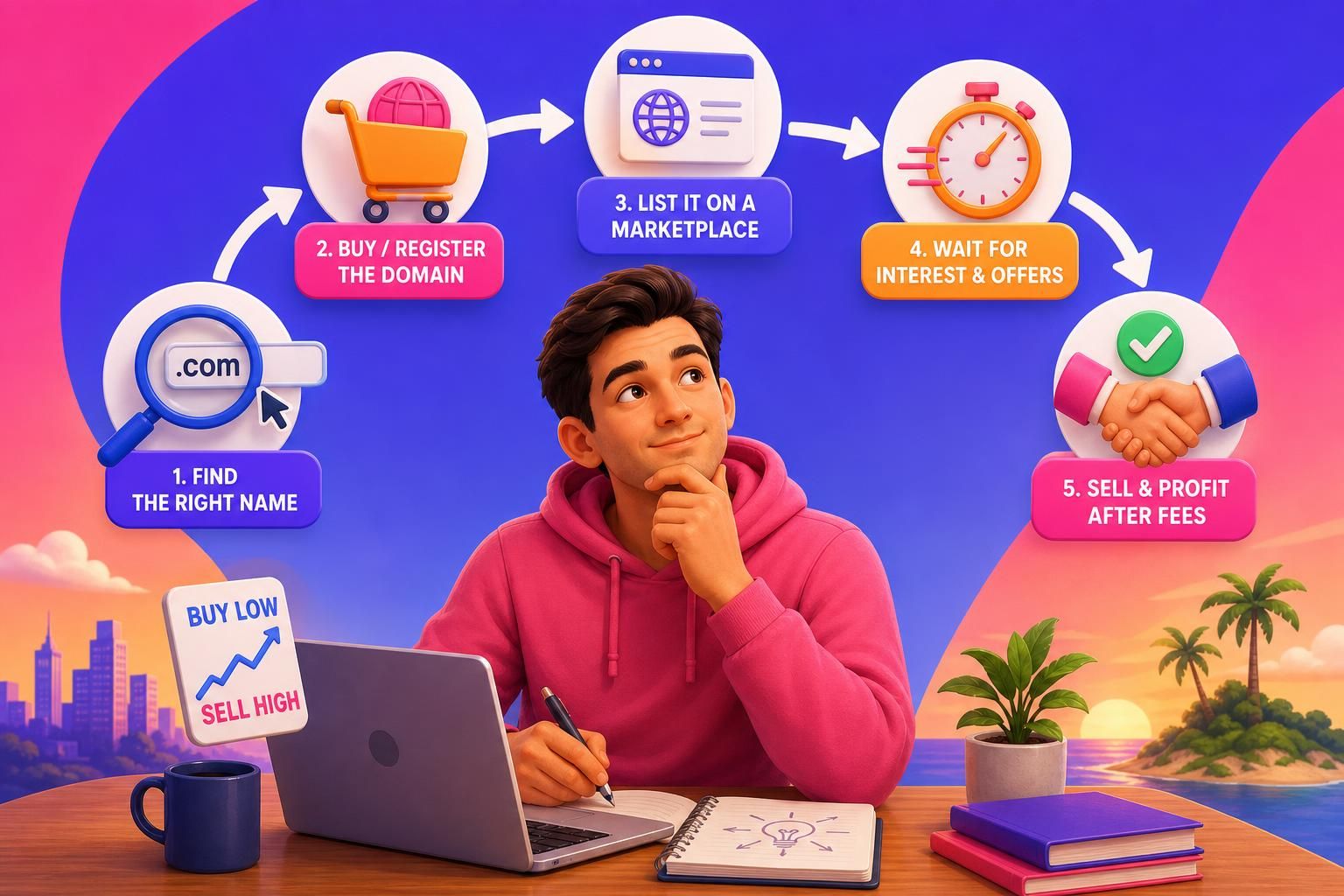
Domain flipping means buying a domain name for less than you hope to sell it for later. In the simplest version, you identify a name with resale potential, register or purchase it, list it for sale on a marketplace, and wait for a buyer. If someone wants the name and your price makes sense to them, the domain changes hands and you keep the difference after fees.
Who this guide is for
This guide is for beginners who want a plain-English explanation before trying the model. It is also useful if you’ve seen appraisals, auction listings, or “AI-assisted” claims and want to understand the basic economics first. The goal is not to promise easy money; it is to help you understand how the process works, what can go wrong, and what you should learn before using any automation.
The big idea in one sentence
Domain flipping is a small-business style speculation model: buy a name with perceived market appeal, hold it while it’s listed, and sell it only if a buyer values it more than you do.
Fundamentals
How the buy-low, list, wait, sell model works
The basic sequence is simple. First, you either register a new domain or buy one from a marketplace, auction, or reseller. Next, you list it where buyers actually shop. Then you wait for interest, respond to offers, and complete the transfer through a marketplace or escrow process. The important part is that most domains do not sell quickly, and many do not sell at all, so the “wait” stage is a real part of the business rather than a minor pause.
For a broader primer on the mechanics of the space, see domain valuation methods and places to sell domains.
What makes a domain valuable
Domain value usually comes from a mix of memorability, commercial meaning, brandability, search relevance, and scarcity. Short names, clear words, strong commercial phrases, and names that fit a growing niche can attract more interest than awkward strings of words. That said, value is not guaranteed by length alone or by a keyword alone. A name can look clever and still be hard to sell if no buyer needs it.
Where marketplaces fit
Marketplaces matter because they supply the audience. Instead of building your own site and waiting for random visitors, you list the domain where buyers already search. Common marketplace structures include auction listings, fixed-price listings, and “make offer” pages. Marketplaces also help with transfer logistics, which matters because domain sales involve registrar changes, payment handling, and confirmation steps.
How renewals and fees affect profit
A domain is not a one-time purchase with no ongoing cost. Most names have annual renewal fees, and those fees can quietly reduce or erase profit if the domain sits unsold. Some buyers also pay marketplace fees, payment processing charges, or transfer-related costs. If you buy too many names and hold them too long, the carrying cost can become the real reason your portfolio loses money.
For a practical look at budgeting these costs, the beginner domain-flipping budget plan is the right companion piece.
What appraisal tools actually do
Appraisal tools and valuation tools try to estimate what a domain might be worth, usually by looking at keyword patterns, comparable sales, length, and other signals. They can be helpful as a rough input, but beginners should treat them as one data point rather than an answer. A number is not the same as a buyer, and a buyer is what ultimately matters.
Main Process / Strategies
Step 1: Choose a narrow buying rule
Beginners usually do better with a simple rule than with a broad hunt across every possible name. For example, you might look only at clear two-word commercial names, only at short brandable names in a specific niche, or only at expired domains that already have some market signal. The point is to avoid buying based on impulse.

Example: A beginner might decide to consider only names that are easy to say, easy to spell, and tied to a real business category such as fitness, software, local services, or e-commerce. That rule is not perfect, but it creates discipline.
Step 2: Check whether the name has resale logic
Before buying, ask three plain questions: Who would want this name? Why would they want it? And what would make them pay more than registration cost? If you cannot answer those questions clearly, the domain may be a guess rather than an investment.
A useful habit is to imagine the likely buyer. A local contractor, startup founder, product maker, or industry publisher may value a name differently from a hobbyist. If you can describe the buyer in one sentence, you are closer to a rational purchase.
Step 3: Start small and account for the full cost
If you want to learn by doing, keep your first test very small. A few low-cost names can teach you more than a large speculative purchase. But “small” does not mean “free,” because registration, renewals, and marketplace fees still apply. A beginner should budget for learning rather than expect the first flip to pay for everything.
Example: Suppose you register one domain for a low introductory price, then renew it once if it does not sell. Your real cost is not just the registration fee; it includes the renewal and any listing costs. If the name later sells, subtract all of those expenses before you call it profit.
Step 4: List it where buyers already search
Once you own a domain, it needs visibility. That usually means listing it on a marketplace, setting a clear price strategy, and making transfer details easy to complete. If you hide a domain in a private portfolio with no sale page and no market presence, your odds of a sale drop sharply.
The practical choice is usually between a fixed price, a make-offer format, or an auction. Fixed price can be easier for beginners because it removes some guesswork. Make-offer can work when you are unsure of value, but it may also invite low bids and slow negotiation.
Step 5: Handle offers carefully
When a buyer contacts you, the goal is to stay rational. Beginners often underprice out of fear or overprice out of optimism. A middle path is better: compare the offer to your costs, compare the name to similar sales, and decide whether the offer fits your target return. If you do counter, keep the response professional and brief.
Step 6: Learn from each outcome
Not every domain will sell, and that is normal. The useful question after each cycle is not only “Did I make money?” but also “Was the buy decision logical?” If the answer is no, review your naming rule, your niche choice, or your holding period. Over time, disciplined review matters more than occasional luck.
A simple hypothetical first-flip walkthrough
Example: You buy a brandable two-word .com that sounds like a software service for a small amount. You list it on a marketplace with a clear price and a “make offer” option. A few weeks later, someone interested in that niche sends a modest offer. You check comparable sales, consider your cost basis and fees, and decide whether to accept, counter, or hold. If the sale closes, your profit is the sale price minus registration, renewals, and marketplace costs.
This is not a guaranteed path; it is just the basic workflow in action.
Where automation may fit later
Only after you understand the model should you consider automation, and even then you should ask what exactly it automates. Some tools may help with discovery, valuation, listing, or messaging, but they do not remove market risk. A tool can speed up a process that you already understand; it should not replace judgment you have not built yet.
FAQs, Mistakes & Expert Insights
Common mistakes beginners make
Overpaying for excitement: New buyers often pay too much for names that sound good to them personally but have weak resale demand.
Ignoring carrying costs: A domain that sits for years can become expensive simply because of renewals and repeated attention.
Buying vague or awkward names: If a name is hard to spell, hard to say, or hard to explain, buyers may skip it.
Confusing appraisal with proof: An estimated value is not the same as market demand.
Holding too many names too soon: A large portfolio of weak domains can create more cost than opportunity.
Misconceptions to avoid
One common misconception is that any short or trendy name will sell. Another is that domain flipping is passive income with no decision-making. In reality, the business is partly research, partly patience, and partly restraint. The best beginner outcome is often not a big sale; it is avoiding bad purchases.
A second misconception is that a domain must be famous to be valuable. Many sales come from ordinary commercial use cases, not celebrity-level names. The right buyer is often a business owner solving a practical branding problem.
Evidence-supported nuance for beginners
Marketplaces and appraisal tools can reduce uncertainty, but neither can eliminate it. A marketplace gives you exposure; an appraisal gives you a signal. The sale still depends on a buyer with a real need and a price they accept. That is why beginner success usually depends more on selection discipline than on enthusiasm or volume alone.
FAQ: Is domain flipping legal?
Generally, yes, buying and reselling domain names is a normal commercial activity. The important caution is that you should not assume a name is safe just because it is available. Trademark issues, misleading branding, or names that target another company’s identity can create serious problems. If a name looks like it trades on someone else’s brand, skip it.
FAQ: Do I need a lot of money to start?
No, not necessarily. A beginner can learn with a small budget if they keep the test limited and understand that renewals and fees still matter. The real question is not “Can I start cheaply?” but “Can I afford to learn without overcommitting to weak names?”
FAQ: How long does it take to sell a domain?
There is no standard timeline. Some domains attract interest quickly, while others sit for a long time or never sell. Factors like niche demand, price, buyer urgency, and marketplace visibility all affect timing. Beginners should plan for uncertainty, not a fixed schedule.
FAQ: Should I trust appraisal tools?
Use them as a guide, not a verdict. Appraisal tools can help you compare names and spot patterns, but they cannot reliably predict a buyer’s willingness to pay. If the appraisal seems high but no one wants the name, the market has given you a different answer.
FAQ: What is the safest way to learn?
The safest way to learn is to buy fewer names, choose clearer naming logic, keep records of costs and outcomes, and review each decision honestly. A small, well-documented test teaches more than a large pile of guesses.
Is domain flipping legal?
Generally, yes, buying and reselling domain names is a normal commercial activity. The important caution is that you should not assume a name is safe just because it is available. Trademark issues, misleading branding, or names that target another company’s identity can create serious problems. If a name looks like it trades on someone else’s brand, skip it.
Do I need a lot of money to start?
No, not necessarily. A beginner can learn with a small budget if they keep the test limited and understand that renewals and fees still matter. The real question is not whether you can start cheaply, but whether you can afford to learn without overcommitting to weak names.
How long does it take to sell a domain?
There is no standard timeline. Some domains attract interest quickly, while others sit for a long time or never sell. Factors like niche demand, price, buyer urgency, and marketplace visibility all affect timing. Beginners should plan for uncertainty, not a fixed schedule.
Should I trust appraisal tools?
Use them as a guide, not a verdict. Appraisal tools can help you compare names and spot patterns, but they cannot reliably predict a buyer’s willingness to pay. If the appraisal seems high but no one wants the name, the market has given you a different answer.
What is the safest way to learn?
The safest way to learn is to buy fewer names, choose clearer naming logic, keep records of costs and outcomes, and review each decision honestly. A small, well-documented test teaches more than a large pile of guesses.
Summary & Next Steps
What beginners should remember
Domain flipping is not magic. It is a small-scale resale model built on judgment, timing, and patience. You buy a name, list it, wait for buyer interest, and hope the sale clears your costs with enough margin to matter. The model can work, but only if you understand the basics before you start buying.
Your next practical move
If you are brand new, start by learning how to evaluate names, how marketplaces work, and how holding costs affect profit. Then choose one narrow buying rule and test it with a small budget. If you later consider automation, compare it against your own process so you know what it truly adds.
For the broader learning path, continue with practical domain valuation, marketplace selection, buying red flags, and the product review for AIFlipDomains Premium if you want to evaluate a tool after understanding the basics.
Bottom line: Learn the model first, spend carefully, and treat every purchase as a decision rather than a hope.
Explore AIFlipDomains Premium to check the current options against your requirements.

[…] By the end of this article, you should be able to look at a domain and form a defensible resale estimate. You will not need a perfect formula. You will need a repeatable method that combines market evidence with plain-English judgment. For a basic overview of how the business model works, see How Domain Flipping Works for Beginners: A Plain-English Starter Guide. […]
[…] Framework for Estimating Resale Potential. If you are still learning the buying process itself, How Domain Flipping Works for Beginners: A Plain-English Starter Guide gives the broader […]