

Commission disclosure: This guide includes one promotional link to Comic Videos AI. The goal here is not to sell you on a tool; it is to help you choose a faceless short-form format that fits your niche, workflow, and monetization path.
If you want to publish Reels, Shorts, or TikToks without showing your face, the real decision is not whether you can make content, but which format you can repeat long enough to learn from it. Comic-style videos can be a strong fit for story-led channels and recurring characters, while simpler faceless formats often work better for explainers, list posts, or high-volume testing. The right choice depends on the job your content has to do, not on which style looks most exciting on day one.
Direct Answer & Introduction
What faceless short-form content is
Faceless short-form content is any short video built without a visible on-camera creator. Common versions include comic-style videos, animated explainers, voiceover-led clips, slideshow posts, and text-first formats. These all solve the same basic problem: how to create useful or entertaining content without relying on a personal on-screen presence.
Who this guide is for
This is for creators who want a practical way to choose a format before they invest too much time in production. If you are deciding between comic-style AI videos, animated content, or simpler faceless posts, the outcome you want is a format that fits your topic, your output capacity, and your plan for growth.
Why the format choice matters
Format affects production time, retention, audience expectations, and later monetization. A style that looks polished but takes too long to make can weaken consistency. A style that is easy to produce but too generic can make it hard to stand out. The best choice is usually the one that you can sustain while still giving viewers a clear reason to watch.
Fundamentals
Core terms and simple definitions
Faceless content means the creator is not the visible presenter. Comic-style video usually combines panels, characters, captions, and some mix of voice, music, or motion. Animation is broader and may include more movement or scene design. Slideshow content typically uses still visuals, text, and pacing to carry the idea.
The most important principle is that each format trades off speed, clarity, and emotional impact differently. Short-form platforms reward fast comprehension and sustained attention, so your format should help a viewer understand the point quickly and keep going long enough to care.
How the main format families differ
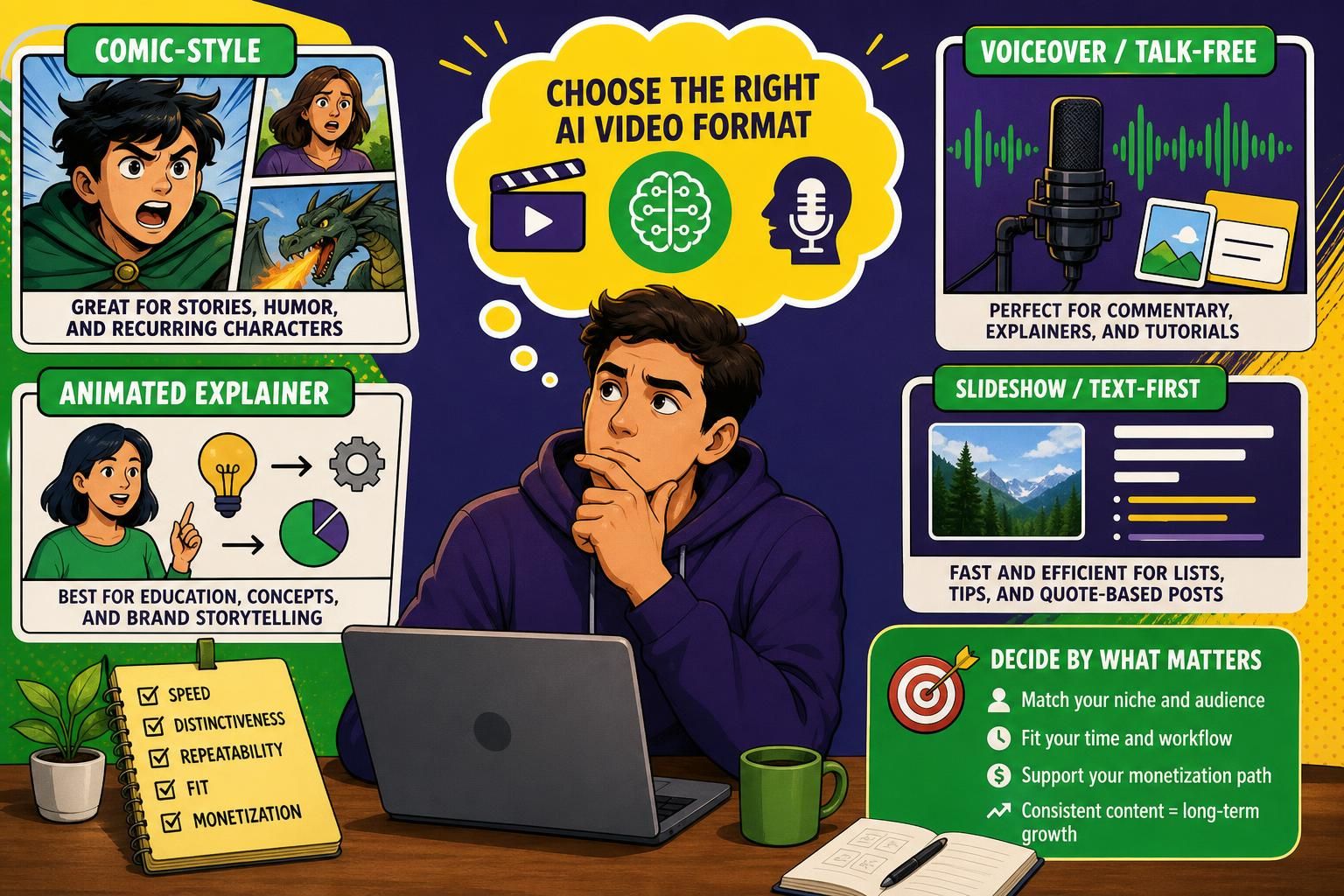
Comic-style content is usually strongest when the content depends on scenes, dialogue, reactions, or recurring personalities. Animated content can work well for education, brand storytelling, or abstract ideas that benefit from motion. Talking-head replacements tend to fit commentary, explanation, and personality-led content. Slideshow formats are often efficient for listicles, quick tips, and quote-based posts.
None of those formats is automatically superior. They succeed in different conditions. The practical question is whether your niche depends more on narrative, explanation, speed, or recognizable style.
Main Process / Strategies
Start with the content job
Before choosing a format, define what the content has to do. Is it supposed to entertain, educate, sell, or build a series with recurring characters? A comic format makes sense when the idea benefits from scenes and dialogue. A simple faceless explainer may be better when the audience mainly wants a quick answer.

Example: A personal finance account might perform better with clean text-led explainers because the audience wants speed and clarity. A fictional story channel may benefit more from comic panels because character expressions and scene changes carry the appeal. A local service business may only need a simple faceless format that highlights the offer, proof, and call to action.
Match the format to your production capacity
Your chosen format has to fit your available time and tolerance for repetition. If you can only produce two videos a week, a highly detailed workflow may slow you down too much. If you can post frequently, a simpler format may let you test more hooks, angles, and topics before you invest in more elaborate production.
Comic-style videos can create visual variety, but they also ask for better planning around characters, pacing, and scene structure. Animated formats can look more polished, yet they may also take longer to assemble if the workflow depends on many separate steps. The right answer is usually the one that lets you stay consistent without feeling trapped by the process.
Choose the format by niche fit
Some niches naturally lean toward certain styles. Storytelling, relationship humor, fantasy scenes, and character-driven content often fit comic-style videos because the format can show emotion and conflict. Education, commentary, and practical instruction often work better with voiceover, captions, and direct visual support. Product-led or service-led content can sit in the middle, depending on whether the message needs proof, narrative, or speed.
A useful question is simple: does this niche need characters, or does it need clarity? If it needs characters, comic-style may be the better choice. If it needs clarity first, a simpler faceless format may be easier to maintain and measure.
Use one primary format during a test window
A common mistake is blending too many styles before learning whether any of them work. Pick one primary format and keep the test window long enough to see patterns. For many creators that means 20 to 30 posts, or a full month of consistent publishing if the cadence is slower.
Example testing frame: Keep the niche, posting rhythm, and topic types similar while you test. If comic-style posts get stronger comments but take twice as long to create, you still have to decide whether the extra time is worth it. If a simpler format gets fewer reactions but lets you publish three times more often, the overall output may be more useful.
Plan the monetization path early
Format choice should connect to how you expect content to pay off later. If your path is affiliate traffic, the format needs a clear hook and a natural bridge to a link or offer. If your goal is sponsorships, the content needs to make the audience and topic obvious. If you want to sell services, the format should be easy to explain and repeat for clients.
Comic-style content can work especially well when the content itself is the product, such as a character channel or story-based brand. It can also support affiliate or lead generation content, but only if the idea stays understandable and the call to action feels relevant rather than forced.
Use a simple comparison matrix
Before you commit, score each format against a few plain questions:
- Speed: How long does one video take?
- Distinctiveness: Does the format stand out in your niche?
- Repeatability: Can you make it again tomorrow?
- Fit: Does it suit your audience and topic?
- Monetization: Does it support your likely revenue path?
This keeps the decision grounded. A format is only useful if it works across several of those criteria, not just one.
Where Comic Videos AI fits into the choice
The official Comic Videos AI sales page checked on 2026-10-07 presents the product as a comic-style video tool with character consistency, voices, captions, music, and a one-time launch-style access model. Those are vendor claims, not verified outcomes. The practical question for a creator is more basic: would a comic workflow reduce enough friction to help you publish consistently? If you want to explore that tool as one option, you can review Comic Videos AI.
That said, a tool does not replace format strategy. Even a capable tool cannot decide whether your audience wants stories, explainers, or simple faceless clips. Start with the content job first, then decide whether a tool helps you execute it more efficiently.
FAQs, Mistakes & Expert Insights
Common mistakes creators make
Choosing a format because it looks trendy. Trendy styles can attract attention, but if they do not fit your niche or workflow, they tend to become exhausting quickly.
Switching too soon. Many creators abandon a format before they have enough examples to learn anything meaningful. Short-form content usually needs repetition before useful patterns appear.
Overbuilding the workflow. If every video takes too many steps, consistency becomes hard to maintain. Reducing friction usually matters more than chasing maximum polish early on.
Ignoring the audience job. Comic-style content can be entertaining, but if the viewer mainly wants a quick answer, too much style can get in the way.
Measuring only views. Depending on your goal, comments, saves, shares, watch time, and profile actions may matter more than raw reach.
Nuanced insight: best does not always mean most impressive
The best faceless format is often the one that lets you publish consistently while still matching audience expectations. In the early phase, a simpler format may beat a more ambitious one because it helps you learn faster. Later, you can add complexity once the topic and hook patterns are already working.
Another useful nuance is that recurring characters can make comic-style content more durable in story-driven niches because viewers recognize the format quickly. But for tutorial-heavy niches, that same style can add work without adding much value.
The goal is not to crown a universal winner. It is to avoid choosing a format that looks exciting but blocks consistency.
Five reader questions answered
1. Is comic-style video better than talking-head-free explainers?
Not always. Comic-style works best when story, humor, or recurring characters matter. Simple explainers are often better when speed, clarity, and volume matter more.
2. Should a beginner start with animation?
Only if the workflow is manageable. Beginners usually do best with the simplest format that still fits the niche, because early consistency matters more than visual complexity.
3. How do I know if my format choice is wrong?
If you keep missing your posting schedule, spending too long on each video, or getting weak audience response after enough samples, the format may not match your niche or workflow.
4. Can I use one format for every niche?
You can, but it is not always ideal. Different niches reward different pacing, visuals, and presentation styles. Educational, entertainment, and product-led content often need different approaches.
5. When should I switch formats?
Switch when the pattern is clear: the format is too slow to sustain, does not fit audience expectations, or keeps underperforming even when your topics and hooks are solid. Change deliberately, not impulsively.
Is comic-style video better than talking-head-free explainers?
Not always. Comic-style works best when story, humor, or recurring characters matter. Simple explainers are often better when speed, clarity, and volume matter more.
Should a beginner start with animation?
Only if the workflow is manageable. Beginners usually do best with the simplest format that still fits the niche, because early consistency matters more than visual complexity.
How do I know if my format choice is wrong?
If you keep missing your posting schedule, spending too long on each video, or getting weak audience response after enough samples, the format may not match your niche or workflow.
Can I use one format for every niche?
You can, but it is not always ideal. Different niches reward different pacing, visuals, and presentation styles. Educational, entertainment, and product-led content often need different approaches.
When should I switch formats?
Switch when the pattern is clear: the format is too slow to sustain, does not fit audience expectations, or keeps underperforming even when your topics and hooks are solid. Change deliberately, not impulsively.
Summary & Next Steps
Make the decision in one sentence
Choose the faceless format that best matches your niche, your production capacity, and your monetization path. If your content depends on scenes, characters, or dialogue, comic-style may be the right lane. If you need speed and clarity, a simpler faceless format may be smarter.
What to do next
Pick one format, publish a small test run, and evaluate whether you can sustain it without burning out. If comic-style is on your shortlist, compare it against easier alternatives first and only add complexity if the content job truly needs it. For readers exploring the comic route in more detail, the related guide How to Create Comic-Style AI Videos: A Beginner’s Workflow Guide covers the production side, while Comic Videos AI Review: Is the Front-End App Worth It for Faceless Short-Form Creators? covers the commercial product decision.
The safest approach is not to chase every new content style. It is to choose one format you can repeat, improve, and use as a foundation for the next stage of your channel.

[…] Most beginners struggle with the same three things: shaping a story for short-form video, keeping characters visually consistent, and making the finished clip understandable on a phone. A good workflow breaks those problems into smaller steps so you can review each part before publishing. If you want help choosing when comic-style video makes sense compared with other formats, see faceless short-form content strategy. […]