

Commission disclosure: This educational guide includes a promotional link to ShopEmpire for readers who want to inspect one tool option in context; if you click and buy, ProdifyDigital may earn a commission at no extra cost to you.
If you want to promote products online but do not want to show your face, use your voice, or build a personal brand first, faceless affiliate video marketing can be a practical route. The outcome is straightforward: you connect a product to an affiliate link, create a short video that showcases the product without putting yourself on camera, and publish it where buyers already scroll. The real question is not whether you can make a video, but whether you can repeat the process often enough to learn what actually gets attention.
This guide is for beginners who want a clear model of how the workflow fits together. It also helps if you already understand affiliate marketing but need a cleaner content system. For a broader tool-evaluation lens, see how to evaluate AI product video tools before you buy and how to find trending products worth promoting.
Direct Answer & Introduction
What faceless affiliate video marketing is
Faceless affiliate video marketing is a content approach where you promote someone else’s product with short-form video, but the video does not require your face, your voice, or a personal creator brand. Instead of filming yourself, you build the content around the product, the offer, and a clear call to action. The affiliate link is the mechanism that tracks referrals and pays a commission according to the program’s published rules.
The reason this model exists is simple: many people want the upside of video marketing without the exposure costs. Those costs can be practical, emotional, or both. Some people do not want to appear on camera. Others do not have a filming setup, editing skill, or spare budget. Faceless content lowers those barriers, but it does not remove the need to choose a product, test ideas, and publish consistently.
Who it tends to suit
This model often suits beginners, introverts, cautious testers, affiliate marketers who already understand commission structures, and store owners or service businesses that want product-style content without filming themselves. It is also useful for people who want to separate their identity from their marketing output. That said, it is not a shortcut to automatic earnings. The work still requires judgement: selecting products, matching the format to the platform, and learning from what gets attention.
Fundamentals
The four moving parts
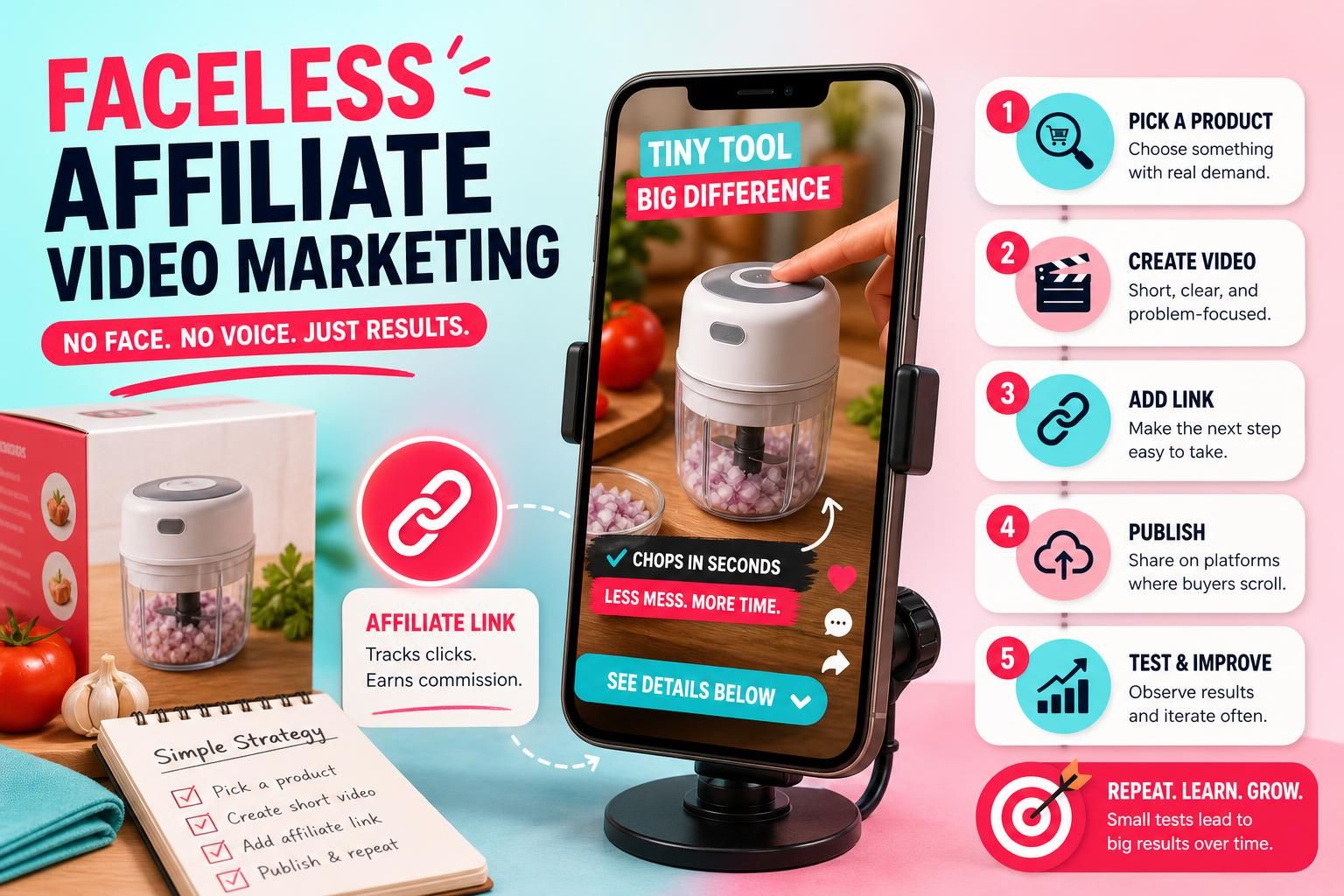
At a basic level, faceless affiliate video marketing has four pieces. First is the product, usually something already selling in a marketplace or niche. Second is the affiliate link, which is how the platform or program knows who referred the sale. Third is the short video, which creates the attention and explains the value visually. Fourth is distribution, meaning the places you publish the video so people can see it.
Those parts work together. If the product is weak, the video has little to amplify. If the video is unclear, the offer does not land. If the link is missing or placed badly, the referral path breaks. If distribution is random, the content may never reach the right viewers. The model is simple to describe, but the results depend on how well the pieces fit.
Why “faceless” is not the same as “effortless”
Faceless does not mean passive. It means you are removing the creator-facing requirements that often slow people down: being on camera, recording a voiceover, or building a recognisable personal brand. You still need a point of view about what to promote and where to post it. In practice, the model shifts effort from performance to selection and repetition.
That distinction matters. A lot of beginners assume faceless content is mainly about hiding identity. In reality, it is more about reducing friction so you can test more products, more hooks, and more formats. The workflow becomes easier to repeat, but the strategic decisions remain human.
A short note on platform fit
Most faceless affiliate videos are short-form because they can communicate quickly and fit common social formats. That does not mean every platform behaves the same way. Some viewers want a fast demonstration. Others respond to a comparison, a problem-solution setup, or a before-and-after visual. The core idea stays the same, but the framing changes by platform and audience.
Main Process / Strategies
Step 1: Pick a product with visible demand
The best starting point is usually a product that already has signs of demand. You are not trying to invent interest from nothing. You are trying to place a useful, attention-friendly video in front of people who may already want the item. That is why many beginners start with marketplace products rather than obscure ideas. A trending or already-selling product gives you a stronger starting signal than a guess.

Example: imagine a compact kitchen gadget that has frequent marketplace reviews and a clear use case. It is easier to make a faceless video around that product than around a vague lifestyle item with no obvious story. You can show the problem it solves, the size of the item, and the result it creates without ever appearing in the frame.
Step 2: Match the product to a simple video angle
Do not start with fancy editing. Start with a clear angle. Common faceless angles include problem-solution, product demo, feature highlight, comparison, or “why this is useful.” The point is to give the viewer one reason to care in the first few seconds.
For example, a cleaning item can be framed around a stubborn mess. A gadget can be framed around convenience. A beauty item can be framed around visible results or routine simplification. The angle should be obvious enough that someone understands the value even without a presenter on screen.
Step 3: Keep the structure short and concrete
A simple faceless video usually works best when it is easy to scan: one product, one problem, one promise, one call to action. If the video tries to do too much, the viewer may not know what they are supposed to notice. Short-form content rewards clarity more than completeness.
A practical structure looks like this: open with the problem, show the product, show the outcome, then invite the click. This can be done with photos, product close-ups, motion graphics, text overlays, or template-based layouts. The important part is not the production style; it is whether the sequence makes sense quickly.
Example: if you are promoting a travel accessory, you might open with “packing too much?” then show the item, then show how it organizes a bag, then finish with “see details.” That is enough for a first test. You do not need a script that sounds like a commercial.
Step 4: Attach the link and reduce friction
The affiliate link matters because it turns attention into a trackable referral. In faceless content, the link is usually placed in the caption, bio, description, or another platform-approved location. The goal is to make the next step obvious and easy. If people have to search too hard, the click rate can suffer.
Be careful not to treat the link as magic. A link only works if the viewer is motivated enough to follow it. That is why the video itself still matters. The link completes the path; it does not create demand by itself.
Step 5: Distribute, observe, and iterate
Faceless affiliate video marketing is usually a testing game. One product may work on one platform and underperform on another. One hook may outperform another. One visual style may suit a gadget but not a beauty item. The practical advantage of faceless content is that it is easier to produce multiple attempts without worrying about your identity or on-camera fatigue.
If you use a tool that helps automate or accelerate the process, the right question is whether it makes testing more disciplined, not whether it promises results. For readers comparing tools, this guide on evaluating AI product video tools is a useful next stop. If your bottleneck is choosing products rather than making videos, this guide on trending product research may help more.
How a beginner might run one campaign
Here is a realistic example. You select one product with clear demand, create three short videos with different hooks, and publish them over a week. One version leads with a pain point, one with a feature, and one with a “why this is useful” angle. You watch which version gets more clicks or saves, then you make a second round that builds on the strongest pattern. That is a more practical mindset than expecting the first post to define the whole business.
This is also where a tool can help if it removes friction from the repetitive parts of production. ShopEmpire’s public starter page, checked on 2026-10-03, describes a faceless product-video workflow that starts from real marketplace photos, attaches an affiliate link, and supports publishing across multiple platforms. It also states that it is aimed at people who do not want to appear on camera and that results are not promised. Those claims describe the workflow, not guaranteed outcomes.
If you want to see one commercial option in context, visit the ShopEmpire page. Use it as one example of how the model can be operationalised, not as proof that the model works by itself.
FAQs, Mistakes & Expert Insights
Common mistakes to avoid
1) Choosing products with no real demand. A faceless video still needs an audience. If there is no visible interest, even a good video may have little to work with.
2) Making the content too generic. “Great product” is not enough. Viewers need a reason to care quickly, such as a pain point, use case, or result.
3) Overcomplicating production. Beginners often spend too long worrying about cinematic quality. Clear and useful usually matters more than elaborate.
4) Forgetting the link path. If the viewer cannot easily move from interest to click, the campaign loses efficiency.
5) Treating one post as a verdict. This model is better understood as a series of tests. One weak post is feedback, not failure.
Misconceptions that slow people down
One common misconception is that faceless means low-trust. In reality, many viewers care more about whether the product is understandable than whether the creator is visible. Another misconception is that you need a large audience first. With affiliate content, the product and the platform can do much of the distribution work if the content is well matched to the audience.
A third misconception is that automation removes strategy. It does not. A tool may help with video creation, scheduling, or template reuse, but it still cannot decide whether the product is worth promoting in the first place. That decision remains yours.
Nuanced insight: the model is best for learners who like iteration
The strongest fit is often someone who can handle small tests and accept that early outputs may be imperfect. Faceless affiliate video marketing rewards people who can compare options, notice patterns, and refine the next post. It is less suitable for anyone who wants one polished campaign to do all the work. If you prefer to stay private and learn by repetition, the model can be a good match. If you want a hands-off income system, it is probably not.
Five reader questions answered
What does faceless affiliate video marketing actually mean? It means promoting products with videos that do not require your face, voice, or a personal brand. The focus stays on the product and the referral path rather than on the creator.
Do I need to be on camera to make this work? No. That is the point of the model. You can build the content from product photos, motion graphics, text overlays, or template-based layouts instead of appearing yourself.
Is this the same as passive income? No. It may be lower-friction than filming yourself, but it still involves choosing products, creating content, and publishing repeatedly. It is more repeatable than a creator-led workflow, not fully automatic.
Can I do faceless affiliate video marketing on a small budget? Yes, often you can start lean because you do not need to buy gear just to test the model. The bigger cost is usually the time and repetition needed to learn what works.
How do I know whether this model is right for me? It tends to fit people who value privacy, can tolerate iteration, and prefer product-focused content over personal branding. It is a weaker fit if you want guaranteed results or dislike ongoing testing.
What does faceless affiliate video marketing actually mean?
It means promoting products with videos that do not require your face, voice, or a personal brand. The focus stays on the product and the referral path rather than on the creator.
Do I need to be on camera to make this work?
No. That is the point of the model. You can build the content from product photos, motion graphics, text overlays, or template-based layouts instead of appearing yourself.
Is this the same as passive income?
No. It may be lower-friction than filming yourself, but it still involves choosing products, creating content, and publishing repeatedly. It is more repeatable than a creator-led workflow, not fully automatic.
Can I do faceless affiliate video marketing on a small budget?
Yes, often you can start lean because you do not need to buy gear just to test the model. The bigger cost is usually the time and repetition needed to learn what works.
How do I know whether this model is right for me?
It tends to fit people who value privacy, can tolerate iteration, and prefer product-focused content over personal branding. It is a weaker fit if you want guaranteed results or dislike ongoing testing.
Summary & Next Steps
The simplest way to think about it
Faceless affiliate video marketing is a practical workflow: choose a product with demand, connect it to an affiliate link, create a short video that explains the value without appearing on camera, and publish it where the audience already spends time. The model exists because many people want to market products without building a creator identity first. Its strength is repeatability; its weakness is that it still depends on judgement and testing.
What to do next
If you are starting from zero, begin with one product, one platform, and one simple angle. Do not overbuild the first version. Learn the format, then improve it. If you want help with the research side, read how to find trending products worth promoting. If your next bottleneck is message quality, how to write better product video hooks and captions will help. And if your main constraint is budget, how to launch a small faceless content workflow on a budget shows a leaner starting point.
For readers who want to see one tool-based implementation, the ShopEmpire page shows how a faceless product-video workflow can be assembled from discovery to publishing. Keep the broader lesson in mind: tools can reduce friction, but the core model still depends on choosing well, testing honestly, and staying consistent.
Continue with a related guide
For commercial investigation, read ShopEmpire – Faceless AI Product Videos From Real Photos.

[…] readers building a broader system, these related guides may help: how faceless affiliate video marketing works, how to evaluate AI product video tools before you buy, how to find trending products worth […]
[…] Product Videos From Real Photos. If you are still learning how product video fits into promotion, How Faceless Affiliate Video Marketing Works is a useful […]
[…] the business model is unfamiliar, the guide to how faceless affiliate video marketing works explains the relationship between useful product content and a referral link. Product selection […]
[…] the referral model is unfamiliar, begin with how faceless affiliate video marketing works. Do not add several channels just because a tool offers them. Each extra destination creates […]