

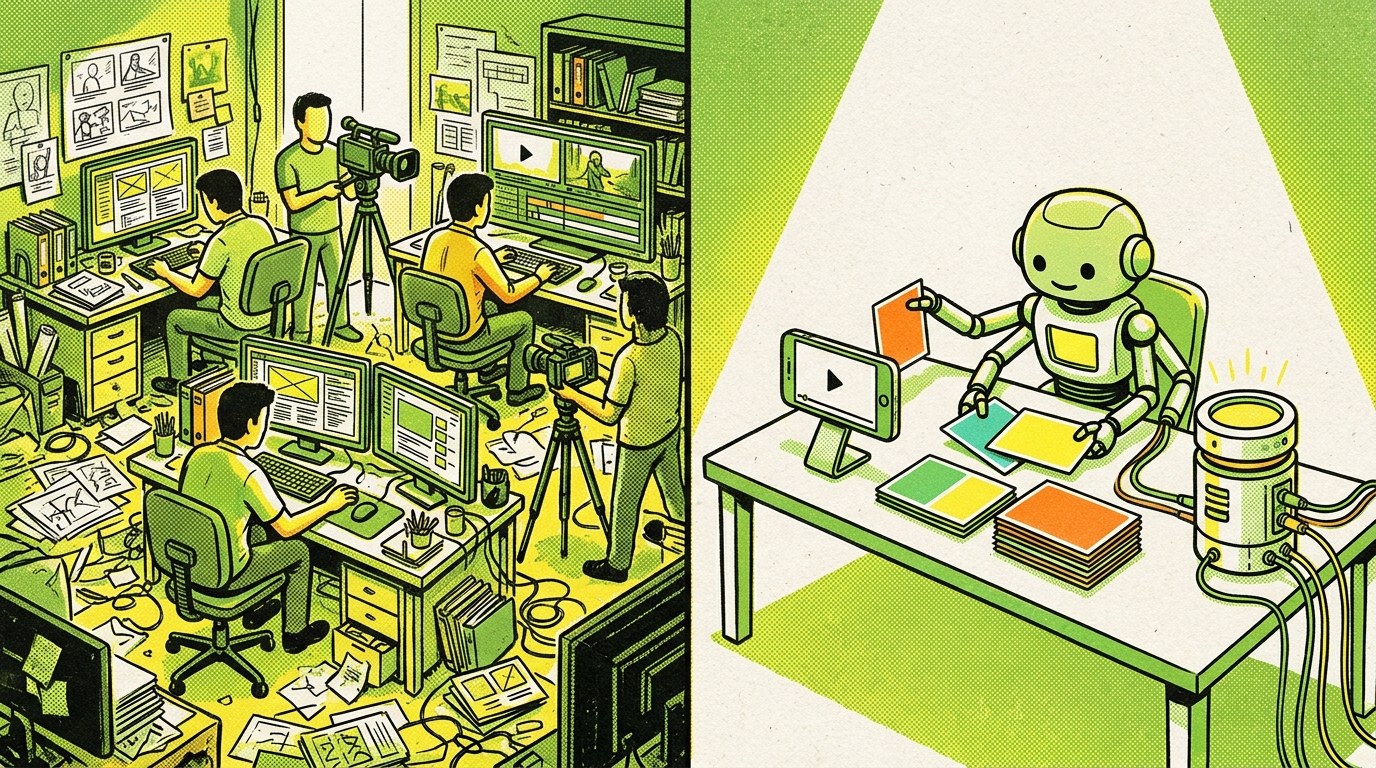
Quick answer
AI marketing agents are general AI agents, such as Grok Bot or Claude Code, set up with three things: your business data, controlled access to your ad platforms, and API tools for images, video and research. In a 9 November episode with Greg Isenberg, marketer Cody Schneider shows an agent turning a brand’s web address into five researched static ads, then building an AI avatar video ad that he says cost about $5, against $300 to $500 for a human-made version. The demos are real, but the costs and results are the guests’ own figures. Treat the workflow as a fast way to draft and test creative, with a human checking everything before it goes live.
Key takeaways
- The agent is only as good as its environment: data, access and tools.
- Read from a warehouse, write to the ad platform. Cody says agents hammering ad APIs directly can breach terms of service and get accounts banned.
- One “skill” file turned a brand URL into five on-brand static ad concepts in the demo.
- AI avatar UGC ads were quoted at about $4.75 to $5 each, rendered at 480p and upscaled to save cost.
- Greg adds two ideas: a large “swipe warehouse” of creative references and a creative director agent that scores every ad.
- Creative volume is the claimed advantage, but how many ads you should test depends on your budget.
- You still own the risk: ad rules, consent for likenesses and spending limits are your job.
🛠️ Practical guides
Ready to put this into practice? These step-by-step guides answer two common follow-up questions:
- How to Build an Ad Swipe File Your AI Agent Can Actually Use — collect and label the ad references that make an agent’s creative better.
- How to Set Up an AI Creative Director to Score Ads Before They Run — a simple scoring gate so weak ads never reach your ad account.
In this guide
- Watch: the source video
- What are AI marketing agents, really?
- What do AI marketing agents need to work well?
- Why should your agent read from a data warehouse?
- How should an agent get access to your ad accounts?
- Which tools does an agent use to make ads?
- How does the static ad workflow work?
- How do AI avatar UGC ads get made for about $5?
- What are the swipe warehouse and creative director ideas?
- What is shown, and what is only claimed?
- What are the risks and rules to watch?
- How can a small business start this week?
- Frequently asked questions
- The bottom line
- Related posts
If you build products and hear crickets, ads are one of the quickest ways to test whether anyone wants what you have made. The trouble is that good ads used to need a designer, a copywriter, a video editor and often a paid creator.
This article breaks down how AI marketing agents are being set up to do that production work, based on a long workshop on Greg Isenberg’s channel. We cover the set-up, the two ad workflows shown, what is proven and what is only claimed, and a calm way to try it without risking your ad account or your budget.
Watch: the source video
What this video covers: Greg Isenberg and guest Cody Schneider walk through the environment an AI agent needs to do marketing work (data in a warehouse, write access to ad platforms and API tools), build static ads live for brands such as Idea Browser, Late Checkout and Cursor, make an AI avatar UGC video ad with motion graphics, and discuss human creators, a swipe warehouse and a creative director agent.
Video: Greg Isenberg (@gregisenberg) with guest Cody Schneider. Cody is the founder of Graphed and demonstrates its tools; Greg says on the show that he is not affiliated with Graphed. This summary and the opinions in it are our own. Costs, speeds and results quoted are the guests’ own figures, not independent tests.
What are AI marketing agents, really?
An AI marketing agent is not a special product. It is an ordinary AI agent given the right data, permissions and tools to do marketing jobs. In the video, Cody uses Grok Bot and Claude Code interchangeably and says the harness matters less than the set-up around it.
His central point is simple. Jobs that used to need several people are now mostly “code and tokens”: writing ad angles, generating images, editing video, adding captions and uploading ads. Greg frames the new job for a founder as building the system around the agents, rather than doing every task by hand. Cody compares it to being a conductor, or a StarCraft player directing many units at once.
If you are new to running several bots, our Grok Bot tutorial on building AI teammates covers the basics.
What do AI marketing agents need to work well?
Cody lists three ingredients: data, access and tools. Miss one and the agent either guesses, breaks things or cannot finish the job.
| Ingredient | What it means | Examples named in the video |
|---|---|---|
| 1. Data | Your ad, analytics, CRM and payment data in one place the agent can query | Airbyte (pipeline) into ClickHouse (data warehouse) |
| 2. Access | Permission to change things on your ad platforms and website | Meta Marketing API, Google Ads API, your CMS |
| 3. Tools | APIs that do the actual making and research | Kie.ai (images and video), fal (transcription), OpenRouter (language models), Apollo or GetLeads (contact data) |
Cody also shows his own company’s platform, Graphed, which bundles all three. He says it is free to start. You can also wire the pieces together yourself, which he calls the open-source route.
Why should your agent read from a data warehouse?
Because ad platform data is huge and messy, and an agent reading it straight from the source tends to flood its memory, make things up or build its own messy copy. That is Cody’s explanation, and it matches what many people see when they point an agent at raw exports.
His fix is a data pipeline that copies data from Facebook Ads, Google Analytics, HubSpot, PostHog and your payment processor into one data warehouse. The agent then queries the warehouse as often as it likes.
The bigger benefit is joining the dots. With everything in one place you can follow an ad from view, to visit, to lead, to sale, and even to customer lifetime value. Cody’s example question is: “When people see ads like this, do we get better customers?” That is a much better question than “Which ad got the most clicks?”
💡 Tip: This is also an ownership win. A warehouse of your own customer and campaign data is an asset you control, not a dashboard you rent. Pair it with an email list so leads from ads become an audience you own. Our guide to owned reach vs rented reach explains why that matters.
How should an agent get access to your ad accounts?
Cody’s rule is that the agent reads only from the warehouse and uses the ad platform’s API only to write: upload creative, pause ads and move ads between ad sets.
His reasoning is that agents can fire off thousands of requests at once. That can break the platform’s API terms, and he believes that is why some people report their ad accounts being banned after letting an agent loose. Greg’s summary is memorable: treat your agent like a drunk patron in a restaurant. Give it limits.
Setting up a Meta Marketing API token takes, by Cody’s estimate, about five minutes, and he links a set-up guide in the video description.
⚠️ Warning: Write access means the agent can spend your money. Before you connect any ad account, set a daily budget cap in the ad platform itself, keep new ads paused until a person approves them, and store API tokens in environment settings rather than chat windows. See how to store AI API keys safely and how to set spending limits for an AI agent.
Which tools does an agent use to make ads?
Tools are the APIs that let the agent actually make things: images, video, voice, transcription, text and contact research. Once these are connected, Cody says the agent can do the “middle work” of marketing.
His standout example is a Google Ads agent that checks each search term your ads appear for and asks whether the searcher is ready to buy from the landing page they land on. He says it can audit 5,000 search terms in about 20 seconds, something no person could do at that speed. That figure is his claim. The idea itself, checking search intent before spending more, is sound and easy to test on a small account.
A practical detail: Cody says you can swap image models through a single API. He prefers OpenAI’s latest image model for static ads, but you could change to another model, such as Nano Banana, with one instruction.
📘 Main article: Want the agent’s ideas to look less generic? Start with how to build an ad swipe file your AI agent can actually use.
How does the static ad workflow work?
In the demo, one command plus a brand’s web address produced five researched static ad concepts, which the agent then rendered and could upload to a new ad set. The skill works through these steps:
- Extract the brand style (fonts, colours, look) from the website.
- Check the Meta Ad Library for the brand’s existing ads, if any.
- Research pain points and desired outcomes from Reddit and social media conversations.
- Propose five ad concepts with headlines and sub-lines for you to approve or change.
- Render the images. For Idea Browser this was quoted at about 17 credits for all five.
- Upload to the ad platform into a new ad set, using the write access set up earlier.
The pair ran it for several brands, including Idea Browser, Late Checkout, Cursor, Aimé Leon Dore, David protein bars, Robinhood and Teenage Engineering. Example headlines included “Stop guessing which idea to build” for Idea Browser. Cody points out you can improve results by giving the agent your own brand style guide as a simple markdown file rather than relying on what it scrapes.
The concept-approval step is the important part. A person still decides which angles are worth paying to test. If you need help writing that input, see how to write a campaign brief an AI marketing team can use.
How do AI avatar UGC ads get made for about $5?
The UGC workflow splits the job into small, controlled steps so the video model has less room to invent things. Cody describes it like this:
- Write the script from the static ad concepts.
- Generate the voice read as an audio file with a voice model.
- Send the script, audio and a reference image to the video model (Seedance) together, so it lip-syncs to real audio rather than mumbling.
- Render at 480p to save money, then upscale with FFmpeg. He says 1080p direct would cost roughly $14.
- Transcribe word by word and compare it with the script, then patch any mispronounced words. His example was the brand name Calendly.
- Add captions and motion graphics with Mirage’s Tesseract tool.
The finished ad was quoted at a projected $4.75, rounded to about $5 with motion graphics. Cody compares that with $300 to $500 or more for a human creator, editor and motion designer. He also admits that some generations still come out garbled and that the first pass was not perfect.
He mentions that the avatar is made by remixing a real creator’s source image, changing the background, age and other details, to avoid a plastic look. That raises consent questions, covered in the risks section below. For human creators, he and Greg mention UGC networks such as Tribe and SideShift, with an example of around $40 per video, and an agent acting as the creator manager.
If you plan a spokesperson-style video, our guide to writing a UGC ad script for an AI spokesperson will help with the words.
What are the swipe warehouse and creative director ideas?
Greg adds two pieces he thinks most set-ups miss: a swipe warehouse and a creative director.
- Swipe warehouse: a large, growing library of great ad examples the agent can learn from. Greg says swipe files made sense before AI, but now you need thousands of references. He mentions Sublime as one tool for collecting them.
- Creative director agent: a reviewer that watches or inspects each first draft, scores it, and refuses to show you anything below about 8 or 9 out of 10. He compares it to automated code review tools such as CodeRabbit.
Cody agrees, and says he already uses a similar review loop for clients in regulated markets such as finance. A vision model checks each image against a list of things the brand cannot say or promise, sends it back for changes and usually passes it within two or three loops.
Cody also warns against a single “god in a box” agent running an ad account, which he says worked badly when they tried it. His preferred approach is to copy what a top media buyer actually does, step by step, and turn each job into its own small workflow.
Put these two ideas to work: build your ad swipe file, then set up an AI creative director to score ads before they run.
What is shown, and what is only claimed?
The video shows real workflows running, but the numbers are the guests’ own and come from a founder with a product to sell. Here is how we would separate the two.
| Shown on screen | Claimed, not independently checked |
|---|---|
| A command turning a brand URL into five ad concepts | That the agent becomes a “top 0.1%” marketer |
| Static ad images rendering for several brands | 5,000 search terms audited in about 20 seconds |
| An AI avatar UGC ad with captions | About $5 per ad, versus $300 to $500 from people |
| The data, access and tools diagram | AI avatars sometimes beating human creators on the same script |
| Shipping 30 to 300 ads a month improving results |
Cody’s point about creative volume deserves care. He argues that Meta’s ad system is good at matching strong creative to the right buyer, so you should give it more ads to test. That can be true for accounts with enough budget. With a small budget, too many ads spread spend so thin that none gets a fair test. He says himself that the right number depends on your budget and cost per lead.
🔎 Unconfirmed / rumour: Nobody in the video shows campaign results such as sales, cost per lead or return on ad spend from these AI-made ads. Treat the workflow as promising, not proven, until you have tested it on your own account with your own numbers.
What are the risks and rules to watch?
- Misleading ads: UK advertising rules say ads must not mislead. Presenting an AI avatar as a real customer sharing their experience is likely to cross that line. Use avatars as presenters, not fake testimonials, and check the ASA and CAP guidance for your sector.
- Likeness and consent: only remix a real person’s image or voice if you have clear written permission for that use. Our guide to AI talking photo videos and consent covers what to check.
- Account safety: agents that overload ad APIs can break platform terms. Keep reads in your own data store and writes small and logged.
- Spend control: cap budgets in the ad platform and keep new ads paused until approved.
- Brand and copyright: using other brands’ ads as inspiration is fine. Copying their designs, wording or trademarks is not.
- Hidden costs: credits, subscriptions and failed generations add up. Track them, as in how to tell if your agent’s work is worth the bill.
For more common pitfalls, see common mistakes when using AI for ads.
How can a small business start this week?
You do not need a warehouse or a funded team to try the core idea. A sensible first week looks like this:
- Pick one offer and write a one-page brief: who it is for, the main pain point and the result they want.
- Collect 20 to 30 ad references you admire into a simple swipe file, following our swipe file guide.
- Ask your agent for five static ad concepts using the brief, your brand colours and the swipe file. Approve or rewrite the angles yourself.
- Score the drafts against a short checklist before you spend anything, using our creative director guide.
- Run a small, capped test with two or three ads, not thirty.
- Send every lead to your email list, so the people you pay to reach become an audience you own.
- Review real numbers after a week and only then decide whether to add data pipelines, write access or video.
Once that loop works by hand, automating parts of it with Zapier or an agent becomes much safer, because you already know what “good” looks like.
Ready to try it? Start with one offer, one brief and five concepts. Then add a scoring step so only your best ideas reach your ad account.
Frequently asked questions
What is an AI marketing agent?
It is a general AI agent, such as Grok Bot or Claude Code, given access to your business data, your ad platforms and creative tools so it can research, make and upload marketing content. The set-up matters more than which agent you use.
Can AI agents really make ads for about $5?
In the video, Cody Schneider quotes about $4.75 to $5 for an AI avatar video ad with motion graphics, using low-resolution rendering and upscaling. That is his figure. Your costs depend on the tools, retries and quality you need.
Do I need a data warehouse to use AI for ads?
No. A warehouse helps when you want an agent to analyse lots of data and link ads to revenue. To start, a brief, a swipe file and a few capped test ads are enough.
Can an AI agent get my Facebook ad account banned?
Cody says agents that send too many requests to ad APIs can break the platform’s terms of service, which can lead to restrictions. He recommends reading data from your own store and using the API only for small, controlled changes.
Are AI avatar ads allowed in the UK?
Using AI presenters is not banned, but ads must not mislead. Do not present an AI avatar as a genuine customer giving a testimonial, and get permission before using any real person’s likeness or voice.
Is Greg Isenberg sponsored by Graphed?
Greg says on the show that he is not affiliated with Graphed. His guest, Cody Schneider, is Graphed’s founder and demonstrates its tools, so treat its features as a founder’s description.
How many ads should a small business test?
Start with two or three per offer on a small capped budget, so each gets a fair share of spend. Add more only when your budget and results support it.
The bottom line
AI marketing agents can now research angles, draft static ads and build avatar videos far faster and more cheaply than a traditional team, provided you give them clean data, safe access and the right tools. The workshop shows the workflow is real. The results and savings are still the guests’ claims. Start small: one offer, a swipe file, a scoring step and a capped test that sends leads to your own email list. Let your own numbers tell you whether to scale.
Related posts
- How to Write a Campaign Brief an AI Marketing Team Can Use
- How to Write a UGC Ad Script for an AI Spokesperson Video
- Common Mistakes When Using AI for Ads

[…] draft variations and fill in the log, which is how marketing engineers scale up. Our article on AI marketing agents shows what that looks like at a bigger […]