

Direct Answer & Introduction
A dashboard full of AI specialists looks useful. But when a client asks for a finished piece of work, the number of assistants matters less than whether you can trust what they produce.

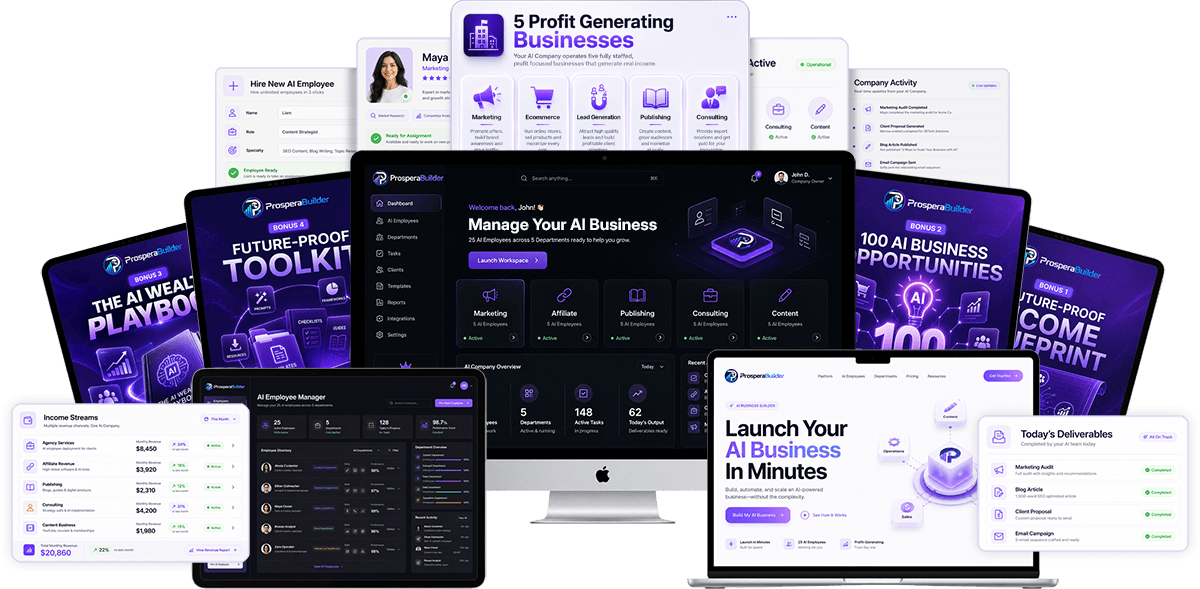
ProsperaBuilder is presented as a cloud-based AI workspace with 25 named roles across marketing, affiliate promotion, publishing, consulting and content. It may suit someone who wants a structured starting point for producing drafts. It is not a substitute for finding customers, understanding their requirements or checking the finished work.
This ProsperaBuilder review helps freelancers and small content businesses decide what to investigate before buying. It evaluates the public offer, not a hands-on account test. You will leave with a practical way to compare the software against one real task rather than an income promise.
Affiliate disclosure: Prodify Digital may earn a commission if you buy through a product link in this article.
Fundamentals
What the offer describes
The seller describes five departments, custom AI roles and access through a browser. Examples of the advertised work include marketing audits, promotional drafts, book descriptions, research reports and video scripts. The public page displayed a $47 one-time front-end price and a 30-day refund promise when checked on 23 September 2026. Confirm the current checkout total and written terms before buying.
That is the product description. Whether a particular output is useful for your customer is a separate question. A fluent draft can still misunderstand the brief, invent a detail or recommend something the customer cannot implement.
Production is not the whole service
Imagine a client asking for a welcome email. Generating several paragraphs is only one part of the job. You also need to know what the subscriber requested, which offer is relevant, which claims are supported and who approves the final version. The service becomes valuable when those pieces fit together.
This is why the most useful buying question is not “How many businesses could I run?” It is “Which piece of work do I already understand well enough to sell and check?” Starting there makes both the software evaluation and the eventual client conversation more concrete.
What remains unverified
This review has not established the exact generation allowances, export formats, commercial-use terms, data-handling arrangements or optional upgrade charges. Ask for those details in writing. A front-end price alone cannot tell you the total cost of your intended workflow.
The seller's footer qualifies its income claims and describes lifetime access in relation to the life of the product. Do not interpret that as guaranteed earnings or an independently guaranteed service duration. Screenshots and testimonials on a sales page are not a forecast of your results.
Main Process / Strategies
1. Pick one deliverable before comparing features
Choose a task with a clear beginning and end: a three-email welcome sequence, a short book description or a content brief. Avoid evaluating the purchase against a vague plan to “start an AI agency.” A broad ambition gives you little basis for deciding whether an output is acceptable.
Write down the inputs you can supply and the deliverable you need back. For a welcome sequence, that might mean an approved product description, a description of the audience, the subscriber's reason for joining and a clear next action. The expected output could be three editable emails with subject lines and a note identifying any missing facts.
2. Give the same brief to the workflow you already use
If you already draft manually or use another tool, keep that as your baseline. Compare equivalent work, not a carefully prepared result from one method against an unedited first attempt from another.
Record preparation time, generation time, revision time and the number of factual corrections. You do not need a complicated score. You need to know whether the new workflow improves the part of the job that is actually slowing you down.
3. Use an acceptance test instead of a vague impression
Hypothetical example: a freelance marketer is preparing a welcome sequence for a local gardening workshop. The approved facts say the class lasts two hours, provides tools and requires advance booking. They do not say the workshop includes refreshments or guarantees that every plant will survive.
A useful brief asks for a friendly introduction, a practical preparation email and a booking reminder. It explicitly prohibits inventing inclusions, deadlines or outcomes. The marketer then checks whether every email reflects those facts and whether the reader can understand the next step without guessing.
If an attractive draft adds “free lunch” or “last three places,” it fails the accuracy check. The fact that the prose sounds confident does not rescue it. If the draft stays accurate but needs a different tone, that is a more manageable editing problem. Distinguishing those failures helps you decide whether the tool saves useful work.
Keep this test small enough to finish. One complete, checked example tells you more about fit than a folder of unfinished samples across five departments.
4. Check the route from generated text to client handoff
Ask how you retrieve and edit the output. Can you copy or export it in a format your client can use? Can you retain the original brief and the reviewed version? What happens to your work if you stop using the product?
Do not upload confidential client material simply to discover how the platform works. Use a fictional brief or public, authorised information for an initial test. Review the provider's data terms and your client's requirements before using sensitive business documents.
5. Decide against a specific threshold
A sensible threshold might be: the output contains no invented offer details, follows the requested structure, exports cleanly and takes less total preparation-and-review time than your existing method. These are suggested evaluation criteria, not measured ProsperaBuilder results.
If the tool meets your needs, you have a reason to consider it. If extensive correction removes the time saving, a larger library of AI roles may not change that conclusion. You are buying a practical workflow, not the appearance of a fully staffed company.
FAQs, Mistakes & Expert Insights
Is this a hands-on ProsperaBuilder review?
No. It is an evaluation of the public offer and the buying questions it raises. We have not tested generation quality, speed or reliability inside a purchased account. The example above is hypothetical and is not evidence of product performance.
Does buying AI software give me a ready-made client business?
No. Software access does not establish customer demand, a service agreement or a reliable delivery process. You still need to identify a useful problem, explain your offer and take responsibility for the work you deliver.
Should I buy all available upgrades immediately?
Start with the requirements of the task you intend to complete. Ask which edition includes those requirements, what it costs and whether any charges recur. There is little value in paying for capabilities you cannot connect to a specific need.
Can I send generated work directly to a client?
Review it first. Check factual accuracy, alignment with the agreed brief, tone, permissions and the final format. A useful draft and an approved deliverable are different stages, even when the draft reads well.
Who is most likely to find this approach useful?
A person with a defined content task, suitable source material and the ability to judge the result has a clearer basis for evaluating the tool. Someone expecting customers or income to arrive automatically is evaluating a different promise—one software alone cannot fulfil.
Summary & Next Steps
Compare the full cost of AI business software, including the time needed to produce reviewed, usable work.
Before promising client work, define the scope of your AI-assisted content service, including revisions and exclusions.
Use the AI client-deliverable review process to check evidence, brief alignment and the final handoff.
Prepare your inputs with the client brief for AI-assisted content, including approved facts and unanswered questions.
Start by choosing one AI-assisted service you can deliver reliably, then assess the software against that defined task.
ProsperaBuilder's structured-role approach is worth evaluating against the work you actually need to complete. The important comparison is not assistant count. It is whether the full process—from brief to checked, usable output—improves your work at an acceptable cost.
Choose one deliverable, define what a correct result looks like and list the plan details you still need confirmed. Then inspect the current offer for ProsperaBuilder with those questions in hand.
You do not need to launch five services at once. You need one useful piece of work you can explain, verify and deliver with confidence.

[…] becomes simpler: can it help produce this output, with these inputs, under these constraints? Our ProsperaBuilder review and buying checklist explains how to assess a structured AI workspace without confusing its advertised roles with a […]
[…] ProsperaBuilder review applies that principle to a buying decision. A software purchase should support a reliable process, […]