

Commission disclosure: This article may include an affiliate link to AI Execution Engine. If you choose to explore it through the link, ProdifyDigital may earn a commission at no extra cost to you.
If you already teach a method, repeat the same advice to clients, or have a framework people keep asking you to explain, the opportunity is not just to create more content. It is to package that knowledge into a guided AI tool that helps someone get from input to outcome faster. The goal is practical: turn what you already know into a focused experience people can use, understand, and potentially pay for.
This guide is for creators, course sellers, consultants, and other experts who want a simple way to convert know-how into a sellable tool without starting from scratch. For readers comparing build options, AI Execution Engine is one example of a platform whose vendor page says it can help users build these tools with no-code setup, connected knowledge sources, and commercial-use rights for included engines, subject to its license terms and platform policies. This article is an educational guide, not a buying verdict.
Direct Answer & Introduction
What you are really building
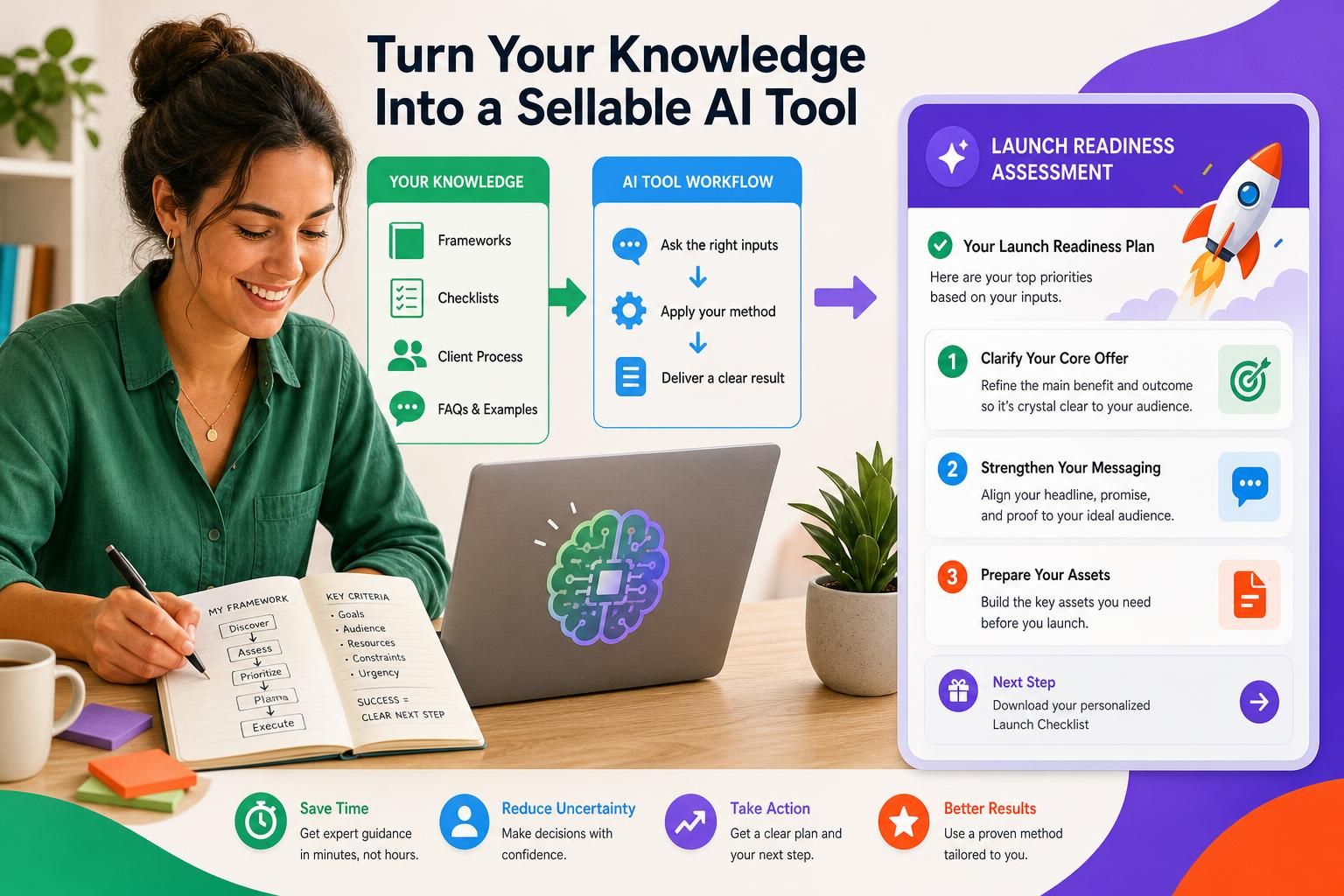
To build a sellable AI tool from existing knowledge, pick one narrow problem you know well, turn your method into a guided workflow, and define a result the buyer can use immediately. The best version of this is not a general chatbot. It is a focused tool that asks for the right inputs, applies your framework, and returns a useful next step in a format your audience already values.
That approach works best for people whose knowledge is repeatable: creators with a teaching method, course sellers with a framework, consultants with an intake or audit process, or niche experts who answer the same questions over and over. If the problem is familiar and the output is clear, you are much closer to a sellable product than you may think.
The practical outcome
The outcome you want is simple: fewer vague explanations, more consistent results, and a product that helps users move forward without needing a live call or custom reply from you every time. In other words, you are converting expertise into a tool that can be used again and again, rather than a one-time explanation.
Fundamentals
From content delivery to guided execution
Traditional content teaches. A sellable AI tool helps someone apply what they already learned. That distinction matters because many buyers do not only want information; they want help making a decision, completing a task, or choosing the next step for their situation. A tool can be more useful than a static download when it reduces the work of figuring out what applies.
The core principle is execution. Your knowledge provides the logic, the AI experience handles the interaction, and the output gives the user something concrete they can act on. That might be a score, a plan, a recommendation, a checklist, or a draft they can refine.
What counts as useful knowledge
Useful knowledge is not limited to a long course or a big curriculum. It can be a framework, an onboarding process, an FAQ set, a client questionnaire, a checklist, a rubric, or a sequence you use to make decisions. If you can explain the process step by step, you probably have enough material to build around.
Example: if you already help clients choose the right service package, your knowledge can become a recommendation tool. It would ask about goals, budget, urgency, and constraints, then suggest a path based on your criteria instead of giving a generic answer.
What makes a tool sellable
A sellable tool solves a visible job. It should give the user a result that is easy to understand, easy to trust, and useful enough to justify access. That could be an audit, a plan, a diagnosis, a shortlist, a score, or an implementation step. The value comes from specificity and relevance, not from stacking on extra features.
Main Process / Strategies
Step 1: Choose one repeated, high-friction task
Start with a problem people already struggle to do well. Strong candidates are tasks that are repetitive, judgment-heavy, or easy to delay: reviewing a sales page, outlining an offer, preparing a launch plan, sorting client intake, or deciding what to do after a lesson.

A good test is whether people already ask you to “just do this for me” or “what should I do next?” Those phrases usually point to work that is structured enough to productize.
Step 2: Define the result before the features
Do not begin by thinking about AI features. Begin with the end state. What should the user walk away with? A useful result is visible and specific: a 90-day plan, a priority list, a scored audit, a customized checklist, or a first-draft recommendation.
Example: a course creator teaching landing pages might build a “Landing Page Fix Finder” that asks about the page’s goal, traffic source, offer type, and current pain points, then returns the top three changes to make first. That is more useful than a broad chatbot that gives general advice and leaves the buyer to sort out what matters.
Step 3: Break your expertise into inputs, rules, and outputs
Once you know the outcome, split the method into three parts:
- Inputs: the minimum information the tool needs to personalize the result.
- Rules: your framework, decision criteria, or sequence.
- Output: the exact format the user receives, such as a score, plan, or recommendation.
This structure helps keep the product focused. It also makes it easier to spot gaps in your method. If you cannot define the needed inputs or the desired output, the idea may still be too vague.
Step 4: Start narrower than you think
The first version should usually do one job well. Narrow tools are easier to explain, easier to improve, and easier for buyers to recognize as relevant. Broad tools often drift into generic advice, which weakens trust and makes the product harder to position.
Example: “content strategy tool” is broad. “Weekly content angle generator for fitness coaches” is more specific, more useful, and easier to market because the audience can immediately see whether it fits them.
Step 5: Design the path from use to purchase
A sellable tool needs a practical business role. It may be a standalone product, a lead magnet, a course add-on, a member-area feature, or a bonus that strengthens another offer. The point is not just to build something clever; it is to place it where people will understand its value and can actually access it.
Example: if you sell a training course, a companion tool can help students turn each module into a personal action plan. That improves usability without replacing the course itself.
Step 6: Build trust into the experience
People usually do not pay because something is “AI-powered.” They pay because the experience saves time, reduces uncertainty, or gives them a better next step. That means your examples, prompts, criteria, and guardrails matter more than flashy branding.
If you are comparing platforms, look for whether the tool helps you define the job clearly, collect the right inputs, keep the output on method, and deliver it in a form your audience can use. For a more systematic framework for comparing products before purchase, see the companion guide on how to evaluate an AI product before you buy.
Worked example: turning a checklist into a tool
Imagine you already use a launch checklist that works well when you talk people through it, but buyers often miss the sequence when they use it alone. You could turn that into a launch-readiness tool that asks about product stage, audience, assets, and launch goal, then returns a tailored checklist in priority order.
In this example, the checklist becomes more usable because the buyer no longer has to decide what to do first. The tool does the sorting for them using your logic. That is the kind of transformation that can make existing knowledge feel product-ready.
FAQs, Mistakes & Expert Insights
Common mistakes and misconceptions
1. Making the tool too broad. Broad tools usually produce broad answers. That lowers confidence and can make the product feel interchangeable with generic AI chat. A narrower promise is usually easier to explain and improve.
2. Starting with the interface instead of the method. A polished layout does not fix an unclear process. First define the logic, then decide how the experience should feel and what it should return.
3. Treating every part of your knowledge as automation-ready. Some parts of your expertise are better handled by a human. Judgment, context, and relationship-based work often support the tool rather than disappear into it.
4. Expecting AI alone to make the product strong. A tool with vague questions and loose criteria will usually produce vague outputs. The quality comes from your structure, not from the idea of AI by itself.
5. Forgetting the delivery path. A good tool still needs a clear place to live, a clear audience, and a clear reason for that audience to use it. Accessibility and placement matter as much as the method.
Nuanced insight: sell the decision support, not the machinery
It helps to think of the product as decision support rather than technology. The buyer is paying for a better answer, a clearer next step, or a faster way to apply your method. The AI is simply the mechanism that delivers that experience.
This matters because it changes what you optimize. Instead of asking how many features you can add, ask what decision the tool helps someone make faster or with more confidence. That question usually leads to better product design.
FAQ 1: What kind of knowledge works best for a sellable AI tool?
Knowledge that is repeatable, structured, and useful across multiple users tends to work best. Frameworks, audits, templates, decision rules, and diagnostic processes are strong candidates because they can be translated into clear inputs and outputs. If your method already produces a consistent result by hand, it is often easier to turn into a tool.
FAQ 2: Do I need to code to build one?
Not necessarily. Many no-code or low-code approaches focus on defining the workflow, the knowledge source, and the output format rather than building software from scratch. The important part is whether the tool consistently guides users toward the result you intend.
FAQ 3: Can I use my existing course or PDF as the knowledge base?
Yes, if the material is organized enough to support the tool’s purpose. A course or PDF can be a good starting point when it already contains your framework, examples, and rules. You may still need to pull out the most relevant parts and simplify them for tool use.
FAQ 4: What should I avoid promising?
Avoid promises of guaranteed income, guaranteed outcomes, or universal usefulness. It is more accurate to promise a better process, clearer guidance, or a more personalized next step. The result will still depend on the user’s situation and how well your method fits it.
FAQ 5: How do I know if the idea is strong enough to sell?
A promising idea usually solves a problem people already recognize, saves time, and produces a result that is easy to understand. Repeated audience questions are a practical signal that the problem is real. You can then test a narrow version before expanding it into a larger product.
What kind of knowledge works best for a sellable AI tool?
Knowledge that is repeatable, structured, and useful across multiple users tends to work best. Frameworks, audits, templates, decision rules, and diagnostic processes are strong candidates because they can be translated into clear inputs and outputs. If your method already produces a consistent result by hand, it is often easier to turn into a tool.
Do I need to code to build one?
Not necessarily. Many no-code or low-code approaches focus on defining the workflow, the knowledge source, and the output format rather than building software from scratch. The important part is whether the tool consistently guides users toward the result you intend.
Can I use my existing course or PDF as the knowledge base?
Yes, if the material is organized enough to support the tool’s purpose. A course or PDF can be a good starting point when it already contains your framework, examples, and rules. You may still need to pull out the most relevant parts and simplify them for tool use.
What should I avoid promising?
Avoid promises of guaranteed income, guaranteed outcomes, or universal usefulness. It is more accurate to promise a better process, clearer guidance, or a more personalized next step. The result will still depend on the user’s situation and how well your method fits it.
How do I know if the idea is strong enough to sell?
A promising idea usually solves a problem people already recognize, saves time, and produces a result that is easy to understand. Repeated audience questions are a practical signal that the problem is real. You can then test a narrow version before expanding it into a larger product.
Summary & Next Steps
Turn one method into one tool
The simplest way to build a sellable AI tool from your existing knowledge is to choose one repeatable task, define one clear result, and structure the experience so the user moves from inputs to outcome with as little friction as possible. If the method is specific, the tool is usually easier to use and easier to position.
Your next step is to review the knowledge you already teach, highlight the questions people ask most often, and pick the problem with the clearest outcome. Then decide whether your first version should be a lead magnet, a course add-on, or a standalone paid tool.
If you want to explore a platform that claims to support this kind of build, AI Execution Engine is one place to review the vendor’s own description, license language, and delivery model. For a wider decision framework, return to the companion guide on evaluating an AI product before you buy.
Continue with a related guide
For commercial investigation, read AI Execution Engine Review: Is It Worth It for Creators and Digital Product Sellers?.

[…] broader planning before you buy, see how to evaluate an AI product before you buy and how to build a sellable AI tool from your existing knowledge. Those guides can help you decide whether you need a product like this now, later, or not at […]